
On this page
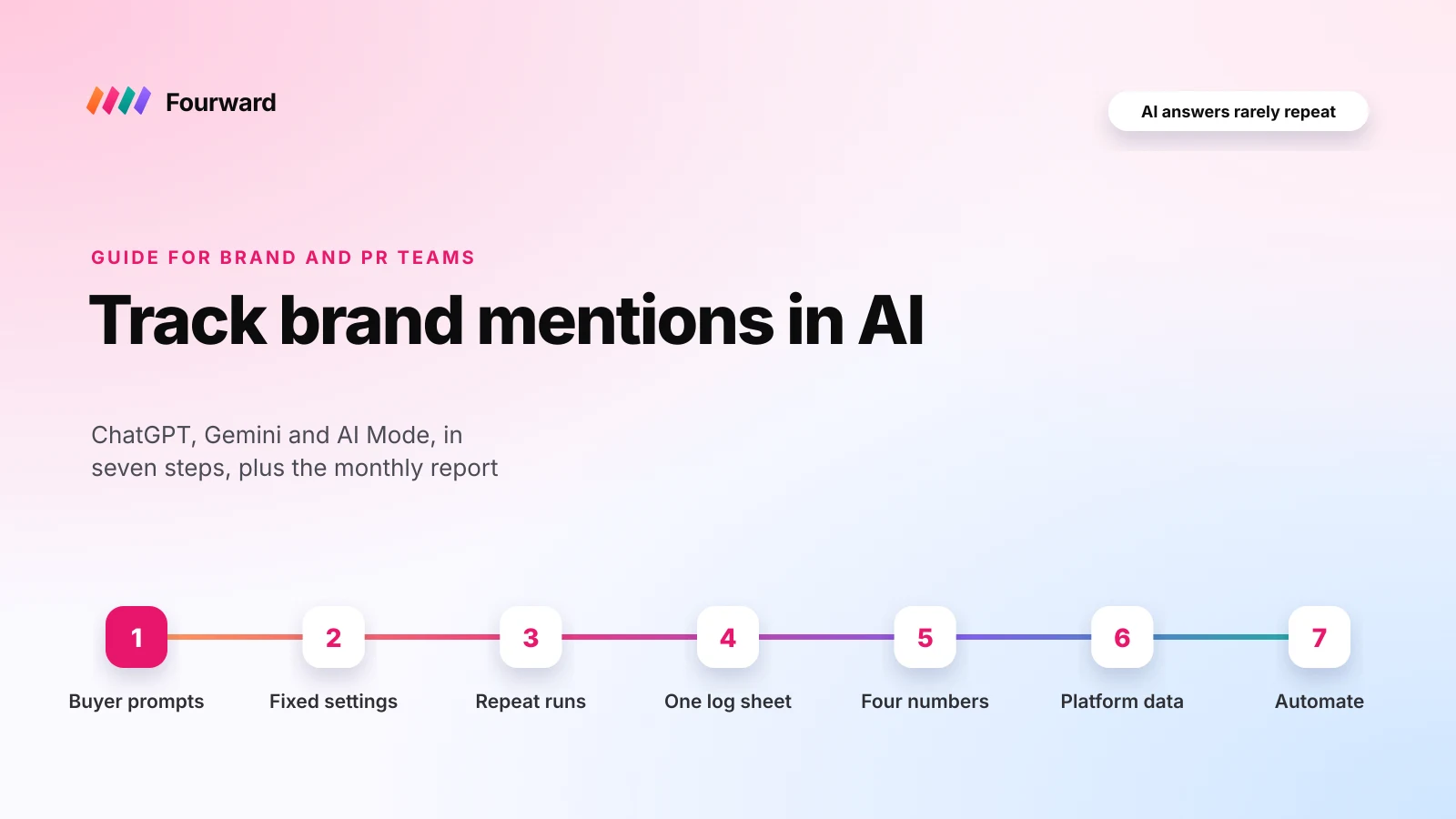
To track brand mentions in AI search, write a fixed list of the questions your buyers ask. Run each question several times a month in ChatGPT, Gemini and Google AI Mode. Log whether your brand is named, how it is described and which sources the answer cites, then report four numbers from that log.
This guide covers what to track, the seven steps, what goes in the monthly report, what tools cost and the mistakes that make the numbers useless.
I lead brand, PR (public relations) and partnerships at Fourward, and our team also works on AI visibility, so I have a stake in this topic. Every number below comes from the publisher's own page, checked on 16 November 2026.
- Tracking brand mentions in AI search means asking AI tools your buyers' questions on a schedule and recording how often they name your brand. It also records how they describe you and what they cite.
- One answer proves little. SparkToro found less than a 1 in 100 chance that ChatGPT or Google's AI gives the same list of brands when asked 100 times.
- Report four numbers: mention rate, share of voice, citation rate and accuracy, for each engine and overall.
- Google Search Console shows AI Overviews and AI Mode impressions for all websites since 31 August 2026. It has no data for ChatGPT or the Gemini app.
- Ahrefs found that brand mentions on other websites track AI Overview visibility far more closely than backlinks. The sources AI answers cite are your PR target list.
What tracking brand mentions in AI search means
AI search means asking a question and getting a written answer from an AI tool, instead of a list of links. This guide covers three of them: ChatGPT, Google's Gemini app and AI Mode, the AI answer tab inside Google Search.
Three words get mixed up in AI reports, so define them before you start:
- Mention. The answer names your brand in its text, with or without a link.
- Citation. The answer links to a page as a source. That page can be yours, or another site's page about you.
- Impression. This is Google's term in its own report. Google says impressions "are how many times links to your site were shown to a user in a generative AI feature on Google Search".
A brand can be mentioned without being cited, and cited without being mentioned. Track both, because each one leads to a different fix. Social listening tools watch public posts and news, but each AI answer is written for one person, so you have to ask the questions yourself.
Why one check is not enough
The most common mistake is asking ChatGPT once, taking a screenshot and calling it a result. AI answers change from one run to the next.
- Brand lists rarely repeat. In January 2026, SparkToro published research in which "600 volunteers ran 12 different prompts through each of the 3 tools a combined 2,961 times". It found less than a 1 in 100 chance that ChatGPT or Google's AI gives the same list of brands when asked 100 times.
- Google's two AI features differ. Google says "AI Mode and AI Overviews may use different models and techniques, so the set of responses and links they show will vary."
- One question becomes many searches. Google's guide to AI features says both may use a "query fan-out" technique. That means running several related searches behind one question, so the cited sources can change even when your question does not.
Measure how often you appear across many runs, not where you appear in one. SparkToro's conclusion is that "visibility % across dozens to hundreds of prompts run multiple times is a reasonable metric".
The seven steps at a glance
| Step | What you do | What you get |
|---|---|---|
| 1. Write buyer prompts | List a few dozen questions buyers ask, in four types | A fixed list you can compare month to month |
| 2. Fix the engines and settings | Test ChatGPT, Gemini and AI Mode with the same country, language and account | Results you can compare |
| 3. Run each prompt more than once | Do several runs per prompt, per engine, in the same week | A rate, not a lucky screenshot |
| 4. Log every answer | Add one row per answer to a spreadsheet | Raw data you can count |
| 5. Work out four numbers | Calculate mention rate, share of voice, citation rate and accuracy | The headline of your report |
| 6. Add platform data | Pull Search Console AI impressions and AI referral visits | A view of whether mentions bring visits |
| 7. Automate when it grows | Let an AI visibility tool run the prompts for you | More prompts with less manual work |
How to track brand mentions in AI search, step by step
You need a spreadsheet, a list of your main competitors and a fixed week each month. Each step below builds on the one before it.
1. Write a list of buyer prompts
A prompt is the question you type into the AI tool. Write the questions a buyer asks before they know your name, not only questions about you.
- Category: What is the best payroll software for a small startup?
- Problem: How do I run payroll for staff in several countries?
- Comparison: What are the best alternatives to [competitor] for small teams?
- Brand: What does [your brand] do, and what does it cost? This type checks accuracy.
Write full questions, the way people talk. On 28 October 2026, Google's CEO said "Queries in AI Mode are on average three times longer than traditional searches". Take real wording from sales calls, support tickets and review sites. Start with a few dozen prompts, then keep the list fixed so each month compares with the last.
2. Fix the engines and settings
Pick the engines your buyers use, and test them the same way every time.
- ChatGPT, with web search on, so the answer shows its sources.
- Gemini, Google's AI assistant app. Google's CEO said in October 2026 that "The Gemini app is now at one billion users".
- AI Mode, the AI tab in Google Search. Track it apart from AI Overviews, the AI summary above normal results, because Google says the two can show different answers and links.
Use the same country, language, device and account each month. Write down the date and any model name the tool shows. Use a clean test account that has never chatted about your company, so your own past chats are not part of the test.
3. Run each prompt more than once
Because answers vary, one run per prompt gives you noise. Run every prompt several times on each engine, on different days of the same week. Repeat the same routine in the same week next month.
Count each run as one answer. For example, 30 prompts on 3 engines with 3 runs each gives 270 answers a month. At that volume, a tool saves real time (see step 7).
4. Log every answer in one sheet
Give each answer its own row. These columns cover everything the report needs:
- Date, engine, prompt and run number.
- Brand named: yes or no.
- Competitors named: every brand in the answer, always spelled the same way.
- How you are described: paste the sentence, then mark it right or wrong.
- Tone: positive, neutral or negative.
- Sources cited: each link, marked as your own site or a third-party site.
Paste the full answer into a final column. When a number moves, you will want to read the words behind it.
5. Work out four numbers
- Mention rate: answers that name you, divided by all answers. This is the headline number.
- Share of voice: your mentions, divided by all brand mentions for you and your competitors on the same prompts.
- Citation rate: answers that link to your own site, divided by all answers.
- Accuracy: correct descriptions of you, divided by all descriptions of you.
For example, if you appear in 81 of 270 answers, your mention rate is 30%. Work out each number per engine as well as overall. A brand can do well in ChatGPT and still be missing from AI Mode.
6. Add the data the platforms give you
Your prompt log shows mentions. Two free reports show what happens after the answer.
- Google Search Console. Search Console is Google's free report on how your site does in Google Search. Its generative AI performance report counts impressions in AI Overviews and AI Mode. Google says it reached all websites on 31 August 2026, and our Search Console AI report guide shows where to find it.
- Clicks from Google's AI answers. Google says these sit in the normal Performance report, under the "Web" search type, mixed with all other web clicks.
- Your analytics tool. In Google Analytics, look at sessions whose source is chatgpt.com or gemini.google.com. These are people who clicked a link in an answer.
None of these reports show a ChatGPT or Gemini mention that got no click. That gap is why the prompt log stays at the centre of the report.
7. Automate when the list grows
An AI visibility tool runs your prompts on a schedule and fills in the log for you. Most also count mentions, share of voice and citations. Our guide to the best AI visibility tools compares them on engines, prompts and price.
Before you buy, check that the plan covers all three engines you track. Some entry plans make you pick a few engines from a longer list, as the cost table below shows.
Free check. 75 checks, one score out of 100, under a minute.
What to report each month
A founder wants three answers from this report. Do AI answers name us more or less than last month, against whom, and what are we doing about it?
| Metric | What it answers | Where it comes from |
|---|---|---|
| Mention rate, per engine | Do AI answers name us? | Prompt log |
| Share of voice | Are we named more or less than competitors? | Prompt log |
| Citation rate | Do answers link to our own pages? | Prompt log |
| Accuracy | Do answers describe us correctly? | Prompt log |
| Top cited sources | Which sites shape the answers? | Prompt log |
| AI impressions | How often do Google's AI answers show our links? | Search Console |
| AI referral visits | Do answers send people to our site? | Google Analytics |
How I would lay out the page
- Headline numbers. Show the four rates per engine, with last month next to them.
- Wins and losses. List the prompts where you appeared or dropped out since last month.
- Wrong facts. List each wrong description, with the page you will fix or the site you will ask to correct it.
- Top sources. Name the third-party sites cited most often, and note whether each one mentions you.
Why I read the sources column first
My work covers press coverage in the trade media buyers read, plus reviews and listings. The sources column shows which of those sites the AI tools actually read.
Ahrefs studied 75,000 brands and found that "Web mentions (0.664) correlate much more strongly than backlinks (0.218)" with brand visibility in AI Overviews. A correlation is not proof, and the study covers Google's AI Overviews only. Still, it points the same way: mentions on other sites matter.
So every cited source that does not mention you is a target. It might be a trade publication, a review site or a "best tools" list. Our guide to product listings for SaaS covers the review sites and directories. Getting your own pages cited is a separate job, covered in how to get cited by ChatGPT.
Manual tracking or a tool: options and cost
You can start for free. Pay for a tool when the prompt list outgrows a spreadsheet, or when you want daily data.
| Option | Price | What it covers | Limits |
|---|---|---|---|
| Spreadsheet, by hand | Free | Any prompt, on any engine you can open | You do every run yourself |
| Google Search Console | Free | Impressions of your links in AI Overviews and AI Mode | Google only, with no prompts or mention counts |
| Otterly.AI Lite | €29 a month | 16 prompts, tracked daily, on "4 of 7 AI engines" | The 7 include ChatGPT, Google AI Mode and Gemini, so check your 4 cover all three |
| Peec AI Starter | $95 a month | 50 prompts, tracked daily, on 3 models you choose | Each extra model costs $30 a month |
Prices come from each vendor's pricing page on 16 November 2026, and they change often. Otterly.AI lists its prices in euros. Peec AI's model list includes ChatGPT, Gemini and AI Mode, so its 3 models can cover the three engines in this guide.
Common mistakes when tracking AI brand mentions
- Judging from one screenshot. Answers change from run to run, so one answer is an anecdote, not a measurement.
- Only asking about your own brand. Brand prompts check accuracy. Category and problem prompts show whether buyers find you before they know your name.
- Changing the prompt list every month. Add new prompts as a separate group, so the core list stays comparable.
- Reporting rank position. The order of brands is even less stable than the list itself. Report how often you appear instead.
- Mixing AI Overviews and AI Mode. Google says the two can show different answers and links, so report them as two lines.
- Blaming content when AI tools cannot read the site. If every engine skips you, check access first. Fourward's free AI visibility check runs 75 checks on what AI engines can read about a site.
- Reporting numbers with no actions. End every report with the wrong facts you will fix and the sources you will approach.
A full SEO, AEO and GEO audit, plus 30 minutes with our team to walk you through it.
FAQs
How do I check if ChatGPT mentions my brand?
Ask ChatGPT the questions your buyers ask, with web search on, and run each one several times. Record whether your brand is named, how it is described and which sources are cited. Repeat the same prompts each month so the results compare.
How often should I track AI brand mentions?
Run a manual check in the same week every month, which is enough for a monthly report. Paid tools such as Otterly.AI and Peec AI track prompts daily if you need closer watch.
What is AI share of voice?
AI share of voice is your brand's mentions divided by all brand mentions for you and your competitors, across the same prompts. It shows whether AI answers name you more or less often than the brands buyers compare you with.
Does Google Search Console show AI Mode data?
Yes. Its generative AI performance report shows impressions in AI Overviews and AI Mode, and Google says it reached all websites on 31 August 2026. It covers Google Search only, so ChatGPT and the Gemini app are not in it.
What is the difference between a brand mention and a citation?
A mention is when the answer names your brand in its text. A citation is when the answer links to a page as a source. You can get one without the other, so track both.
Can I track AI brand mentions for free?
Yes. A spreadsheet, a fixed prompt list and Google Search Console cost nothing. If you want a paid tool, Otterly.AI's Lite plan was €29 a month on its pricing page on 16 November 2026.
Sources
- New research: AIs are highly inconsistent when recommending brands or products, SparkToro, 28 January 2026, checked 16 November 2026.
- Generative AI performance report (Search), Google Search Console Help, checked 16 November 2026.
- AI features and your website, Google Search Central, checked 16 November 2026.
- Q3 2026 earnings call: Remarks from our CEO, Google, 28 October 2026, checked 16 November 2026.
- An Analysis of AI Overview Brand Visibility Factors (75K Brands Studied), Ahrefs, 26 May 2025, checked 16 November 2026.
- OtterlyAI Pricing, Otterly.AI, checked 16 November 2026.
- Pricing for Peec AI, Peec AI, checked 16 November 2026.