
On this page
A product listing for SaaS is a public profile of your software on a site where buyers find, compare or buy tools. The main places are review sites such as G2, cloud marketplaces such as AWS Marketplace, partner app stores and launch sites such as Product Hunt. Start with the free review-site profiles, and keep the same facts on every listing, because buyers and AI answers both draw on them.
This guide covers where to list, how to set up each profile, what it costs, how to get reviews within the rules, and the mistakes to avoid.
I lead search, content and AI visibility at Fourward, so I have a stake in how SaaS companies show up in AI answers. Every fee and rule below comes from each company's own page, checked on 12 November 2026. The AI citation data comes from a study that G2 published, and G2 sells listings, so read those numbers with that in mind.
- A SaaS product listing is a public profile of your software on a review site, marketplace or launch site where buyers find and compare tools.
- G2 says you can claim your profile for free. Product Hunt says launching costs nothing.
- Amazon Web Services (AWS) Marketplace charges 3% on public SaaS sales. Microsoft charges a 3% store service fee on offers it sells for you.
- A G2 study links more reviews to more AI citations, but reviews explain less than 2% of the variance.
- US rules ban buying reviews and rewarding only positive ones.
What a SaaS product listing is, and why AI answers read it
A product listing is the page about your software on someone else's site. It usually holds your description, category, pricing, screenshots, integrations and user reviews.
Why buyers use listings
A third-party page shows reviews you did not write, so buyers can weigh what other users say. Review sites also let buyers compare several tools in one category on one page.
Why AI answers use them
AI tools such as ChatGPT and Perplexity search the web when a buyer asks for software suggestions. The pages they find include review sites, comparison posts and directory profiles. I explain how that search works in my guide on how to get cited by ChatGPT.
G2 published a study of 30,000 AI citations across 500 software categories. The study found that "Categories with more G2 Reviews get more AI citations and a higher SoV", where SoV means share of voice. The same study says reviews "explain less than 2% of the variance", which makes them "a small piece of a larger puzzle".
A listing matters most as a source of correct facts about you. An out-of-date price on a review site can become an out-of-date price in an AI answer.
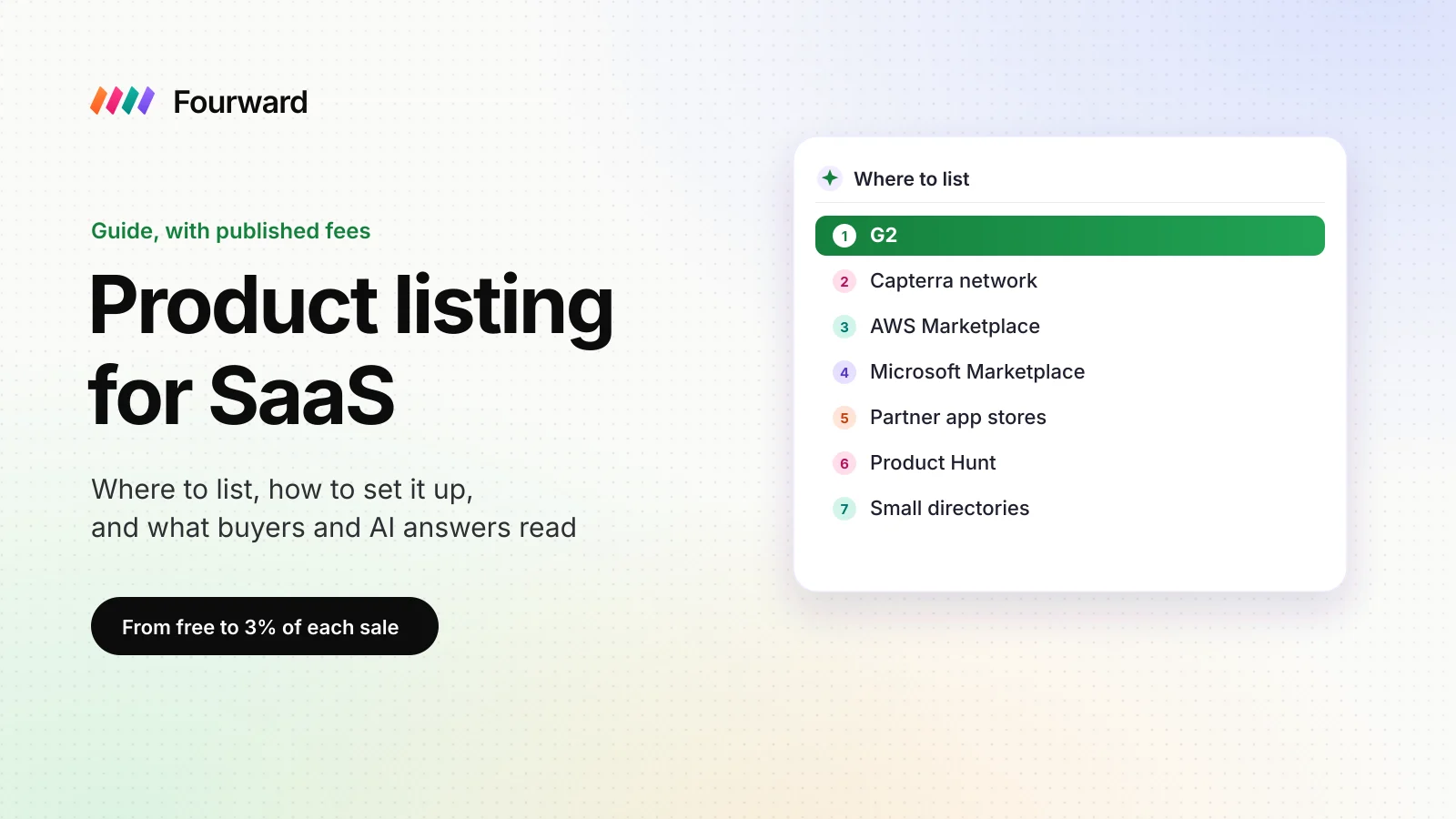
Where to list a SaaS product: the options at a glance
| Where | Type | Cost to start | Best for |
|---|---|---|---|
| G2 | Review site | Free to claim a profile | B2B buyers comparing tools in a category |
| Capterra, GetApp, Software Advice | Review sites | Check the vendor sign-up page | Buyers comparing tools in a category |
| AWS Marketplace | Cloud marketplace | 3% of each public SaaS sale | Buyers who pay through their AWS account |
| Microsoft Marketplace | Cloud marketplace | 3% store fee when Microsoft sells for you | Buyers who pay through their Microsoft account |
| Partner app stores | Integration directory | Set by each partner | Buyers who already use the tool you connect to |
| Product Hunt | Launch site | Free to launch | Early users and feedback around a launch |
Review sites: G2 and the Capterra network
Review sites are where B2B buyers compare software by category and read what users say. Most SaaS companies should start here, because a basic profile costs little and buyers already search these sites.
G2
G2 is a review site for business software. Its vendor page tells vendors: "You can claim your profile for free".
- If your product is already on G2: G2 tells vendors to "claim your G2 listing so that you can make any necessary updates". Someone may have added your product before you did.
- If it is not on G2 yet: submit it from the same page. G2 says that after you submit, "your product or service will be conditionally approved".
The G2 article on AI citations also quotes a Radix analysis that found G2 has "the highest influence for software-related queries" among sources AI tools cite. Remember that G2 is reporting on itself.
Capterra, GetApp and Software Advice
Capterra, GetApp and Software Advice are three review sites that Gartner owned. In January 2026, G2 announced that it "has formally agreed to acquire" the three sites from Gartner.
G2 says the combined network "will reach 200+ million annual software buyers". Because ownership is changing, check each site's current vendor sign-up page and fees before you create a profile.
Other review sites in your category
Smaller and niche review sites can matter more in some categories. Ask ChatGPT and Perplexity five questions your buyers ask. Add every review site they cite to your list.
Cloud marketplaces and partner app stores
A cloud marketplace lets a company buy your software and pay through the account it already has with that cloud provider. Marketplaces suit products sold to larger companies that already run on that cloud.
AWS Marketplace
AWS Marketplace lists its fees on one documentation page. The listing fee for public SaaS offers is 3%.
- How the fee works: AWS says the fee "is calculated based on the pre-tax Total Contract Value", meaning the full value of the deal before tax.
- Private offers: deals you negotiate for one customer have their own fee tiers on the same page.
- Since when: AWS says its current listing fees have applied since 5 January 2024.
Microsoft Marketplace
Microsoft's publisher documentation says "Either the publisher or Microsoft is responsible for managing software license transactions". The listing option you choose decides who handles the sale.
- The fee: Microsoft "charges a 3% standard store service fee when customers purchase your transact offer". A transact offer is one that Microsoft sells and bills for you.
- The technical bar: a SaaS offer that Microsoft sells must be "a multitenant solution", meaning one copy of your app serves many customers. It must also use Microsoft Entra ID, Microsoft's sign-in service, and connect to Microsoft's fulfilment APIs.
Partner app stores
If your product connects to other software, ask each partner to list you in its app directory. Buyers in a partner's directory already use that partner's tool, so the fit is clear. Each partner sets its own rules, so read its listing requirements first.
Partner listings also earn links from sites your buyers trust. I cover that side in our guide to SaaS link building.
Launch sites and small directories
A launch site features new products for a day. Small directories list software by category, usually for free.
Product Hunt
Product Hunt's help centre says launching "costs nothing". It also says: "Our team reviews every launch and hand-picks which ones to feature on the homepage leaderboard". Featured launches then compete for the day's ranking, including Product of the Day.
In my view, for most B2B products a Product Hunt launch brings early users and feedback rather than a steady flow of buyers. Keep the page accurate after launch day, like your other listings.
Small software directories
Many small directories accept free submissions. Pick the few that rank in Google for your category or appear in AI answers. Skip paid services that submit your product to large numbers of directories at once.
Free check. 30 checks, one score out of 100, under a minute.
How to set up a listing that buyers and AI can use
The same seven steps work on every site. Do them once for your first listing, then reuse the work.
- Write one fact sheet. Put your product name, a one-sentence description, categories, prices, integrations and support contacts in one shared document. Copy from it for every listing.
- Claim before you create. Search each site for your product first. A duplicate profile splits your reviews across two pages.
- Use your real product name. Match the name on your website exactly. Extra keywords in the name look like spam to buyers.
- Choose the category buyers search. Pick the one or two categories where buyers would look for you, not every category you could fit.
- State the price in a sentence. Write the price, the unit and what it includes, such as "per user per month, billed yearly". A plain sentence is easier for buyers and AI tools to quote than a table.
- Add screenshots and a short demo video. Show the screens buyers ask about in sales calls.
- Set a review date. Check every listing each quarter, and on the day your pricing or packaging changes.
How to get reviews without breaking the rules
Reviews are what make a review-site profile useful to buyers. The safest way to get them is to ask real customers at natural moments, such as after onboarding or at renewal.
What US rules ban
The Federal Trade Commission (FTC), the US consumer protection agency, finalised a rule on fake reviews in August 2024. The rule covers three practices that matter for software reviews.
- Buying fake reviews: the rule bars businesses from buying fake reviews or getting them from company insiders, such as staff.
- Rewarding only good reviews: it bans "providing compensation or other incentives conditioned on the writing of consumer reviews expressing a particular sentiment".
- Pressuring critics: it bans "using unfounded or groundless legal threats, physical threats, intimidation, or certain false public accusations" to stop or remove negative reviews.
What to do instead
Ask every customer in a group, such as everyone who renewed this quarter, not only the ones you expect to be happy. Read each review site's own rules before you offer any thank-you gift. Reply to negative reviews in public with facts and a fix.
What a SaaS product listing costs
Many listings are free to start. You pay for them in three other ways.
- A share of sales. AWS Marketplace takes 3% of public SaaS sales. Microsoft takes 3% on offers it sells for you.
- Paid plans and ads. Review sites sell extra profile features and ads. Ask for a written quote, and compare it with what one new customer is worth to you.
- Time. Someone has to claim profiles, ask for reviews and update prices. Plan a few hours each quarter.
Mistakes that make listings work against you
- Different facts on different sites. A buyer or an AI tool that finds two different prices cannot tell which one is right.
- Unclaimed profiles. A profile someone else created may show an old logo, an old price or a competitor's category.
- Bulk directory submissions. Google treats low-quality directory links as link spam, as our SaaS link building guide explains.
- Hiding bad reviews. Buyers may doubt a profile with only five-star reviews, and the FTC rule bans pressuring critics.
- Too many listings at once. In my view, three accurate profiles with recent reviews do more than ten neglected ones.
How to check that your listings are working
- Ask AI tools your buyers' questions each month. Note which listings ChatGPT and Perplexity cite, and whether the facts they quote are current.
- Watch referral traffic. In your analytics, filter visits from each review site and marketplace.
- Check what AI can read on your own site. I built Fourward's free AI visibility check, which runs 30 checks on what AI engines can read about a site.
Listings are one part of GEO (generative engine optimization), the work of showing up in AI answers. Our GEO guide for B2B SaaS covers the other parts.
A full SEO, AEO and GEO audit, plus 30 minutes with our team to walk you through it.
FAQs
What is a product listing for SaaS?
A SaaS product listing is a public profile of your software on a site where buyers find, compare or buy tools. Examples are review sites like G2, cloud marketplaces like AWS Marketplace and launch sites like Product Hunt.
Is it free to list a SaaS product on G2?
Yes. G2 says you can claim your profile for free. New products are conditionally approved after you submit them.
Do G2 reviews help a product show up in ChatGPT?
A little. A G2 study of 30,000 AI citations found categories with more G2 reviews get more AI citations, but reviews explained less than 2% of the variance.
Can I pay customers to leave reviews?
The US Federal Trade Commission's rule on reviews bans buying them and bans rewards tied to positive reviews. Read each review site's own rules before you offer any thank-you gift.
How much does AWS Marketplace charge SaaS sellers?
AWS lists a 3% fee on public SaaS offers, calculated on the pre-tax total contract value. Private offers have their own fee tiers.
How many sites should a SaaS product be listed on?
Start with the two or three review sites that AI tools cite for your category, plus the app stores of partners you integrate with. Add more only when you can keep each one current.
Sources
- Create a Profile, G2, checked 12 November 2026.
- G2 to Acquire Capterra, Software Advice, and GetApp from Gartner, G2, 29 January 2026.
- Do More G2 Reviews Mean More AI Visibility? Insights from 30k Citations, Kevin Indig for G2, 23 October 2025, checked 12 November 2026.
- Understanding listing fees for AWS Marketplace sellers, Amazon Web Services, checked 12 November 2026.
- Microsoft Marketplace transact capabilities, Microsoft Learn, updated 22 July 2026, checked 12 November 2026.
- How Product Hunt works, Product Hunt Help Center, checked 12 November 2026.
- Federal Trade Commission Announces Final Rule Banning Fake Reviews and Testimonials, Federal Trade Commission, 14 August 2024.