
On this page
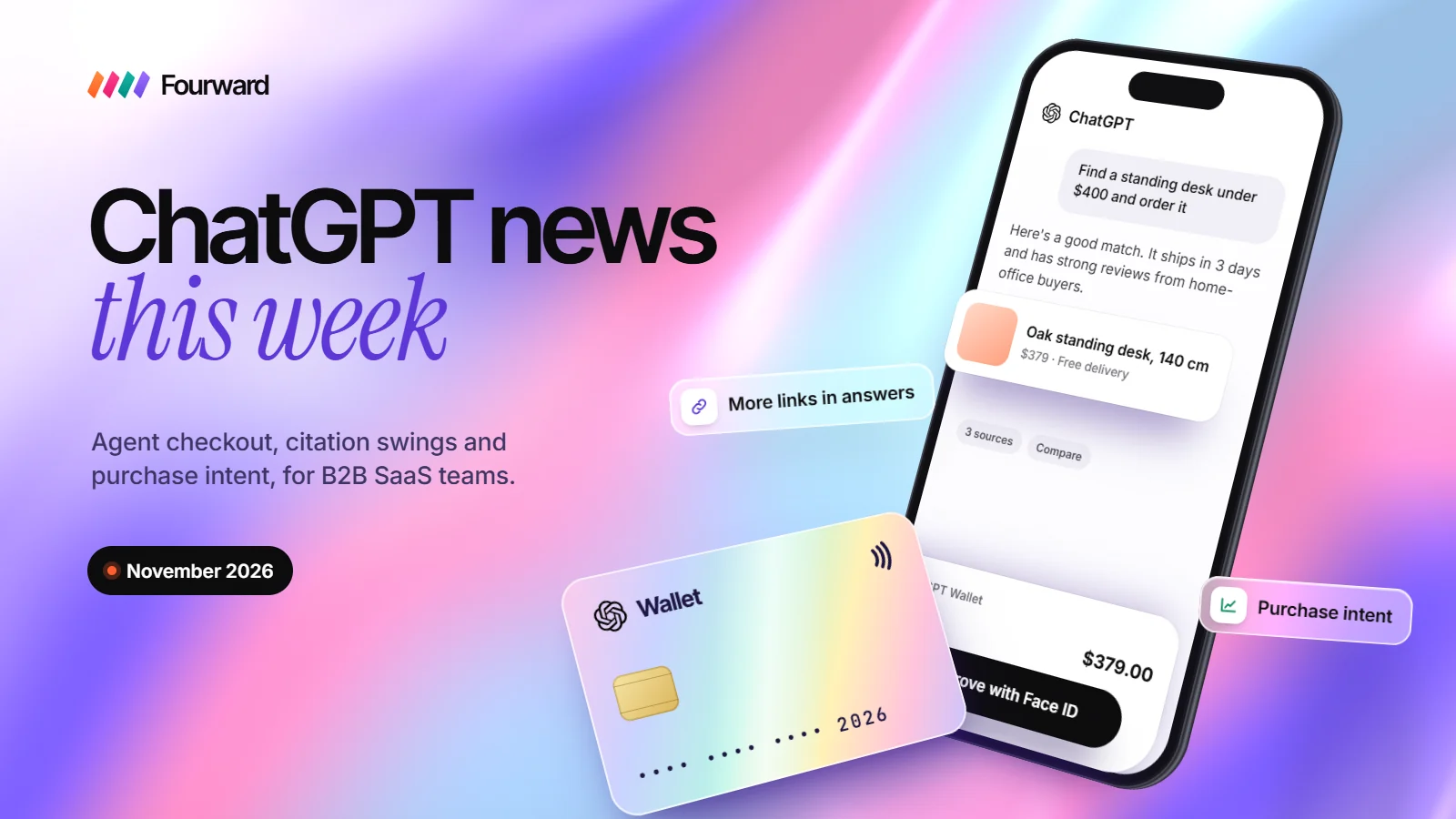
This week's ChatGPT news has three parts that matter to marketers. On 13 November 2026, OpenAI launched ChatGPT Wallet, which lets its agents buy things for a limited number of US Pro subscribers. Tracking firms reported big swings in how often ChatGPT cites websites. A SparkToro study found that only 6.9% of prompts involve researching a brand to buy from.
For most B2B SaaS teams, I read these as reasons to change how you measure ChatGPT, not to rebuild your plans. This post covers each change, what it means for B2B SaaS, and the six steps I would take next.
- ChatGPT Wallet is OpenAI's new payment feature for agents: it lets OpenAI's agents, called dots, buy from merchant websites after the user approves each purchase.
- Wallet starts with a limited number of US ChatGPT Pro subscribers, who approve each purchase with Face ID or a fingerprint.
- In Goodie's tracking, ChatGPT answers with zero sources rose from 1.5% to 12.2% on 31 October 2026.
- Peec AI says ChatGPT now links to websites in 48% of chats, up from 10%, but it has not published a method.
- SparkToro found that 6.9% of 118,163 prompts showed research into a brand to buy from.
This week's ChatGPT news at a glance
| Change | When | Source | What it means for B2B SaaS |
|---|---|---|---|
| ChatGPT Wallet for agent checkout | 13 November 2026 | OpenAI launch, reported by TechCrunch | Little today, since it starts with some US Pro users and retailers |
| More answers with zero sources | From 31 October 2026 | Goodie's tracking | Citation counts can fall with no change to your site |
| More links inside answers | Rising since early October | Peec AI, no method published | More chances of a click, but most links are not citations |
| Purchase intent study | 17 November 2026 | SparkToro, US panel | Buying research is a small share of ChatGPT use |
I lead lifecycle and demand generation at Fourward, a marketing team for search, AI visibility, brand and lifecycle work. I could not load OpenAI's own announcement page on 18 November 2026, so the Wallet details come from TechCrunch's report. Citation and intent figures come from the firms that published them. Where I give advice, I say it's mine.
What ChatGPT Wallet is and who can use it
An agent is AI software that carries out tasks for you, such as searching, comparing and buying. OpenAI calls its agents dots. TechCrunch reports that dots help users "decide what to buy and then complete the purchase on your behalf." ChatGPT Wallet is the payment step that makes the purchase possible.
Who can use it now
- TechCrunch says: "The option will initially be available to a limited number of U.S. ChatGPT Pro subscribers."
- Users approve each purchase with a security check, such as Face ID or a fingerprint.
- OpenAI plans to let users set spending limits, but that control is not live yet.
- OpenAI also wants agent shopping to work at more supported retailers over time.
What is still unclear
I found no date for other plans or other countries in the coverage I read. Nothing I read says whether agents can buy software subscriptions through Wallet. The coverage talks about retailers and shopping.
Does agent checkout matter for B2B SaaS yet?
My view is that it doesn't matter for most B2B SaaS companies yet. Wallet starts with consumers on one paid plan in one country. B2B software is usually bought through demos, trials, security reviews and contracts, not one card payment.
Self-serve plans are the exception. If a buyer can pick a plan and pay by card on your site, an agent may one day do those steps for them. The work that prepares you for that also helps human buyers today:
- Put plan names, prices, seat limits and what each plan includes in plain text on the pricing page.
- Keep the sign-up path for self-serve plans short, with no required sales call.
- Check that your bot rules and firewall don't block AI agents on pricing, sign-up and help pages.
OpenAI's crawler documentation says it "also uses ChatGPT-User for certain user actions in ChatGPT and Custom GPTs." A user agent is the name a bot gives when it visits a site. OpenAI adds that robots.txt rules may not apply to these actions, because a person started them. robots.txt is the file that tells bots which pages they may visit.
So for agent visits, your firewall settings may matter more than your robots.txt file. I could not confirm which user agent dots uses when it shops. Our explainer on what an AI crawler is covers the different OpenAI bots.
Why ChatGPT citations swung this month
A citation is a link to a page that ChatGPT used as a source for its answer. Two tracking firms published ChatGPT link data in the past week. One firm saw fewer sources in answers, and the other saw more links.
Fewer sources in some answers
Goodie, a company that tracks AI answers, reported a sudden drop. Its post says: "On October 31, 2026, the share of ChatGPT answers with zero cited sources jumped from 1.5% to 12.2% in our tracking." Goodie also saw citations per answer fall from 5.44 to 4.53.
Goodie says most of the loss is answers with no sources at all, "which is what a skipped search looks like." If Goodie is right, ChatGPT ran fewer web searches. It answered more often from what the model learned in training.
More links in other answers
Peec AI, another tracking firm, reported a rise in links. PPC Land sums up its finding: "ChatGPT now links to websites in 48% of chats, up from 10%; 63% of links are not citations." PPC Land says the share stood at around 10% until early October.
These are clickable links inside the answer text, not the list of sources. PPC Land also notes that Peec AI's post "gives no sample size, prompt set, market, language, ChatGPT plan or login state." So I treat the 48% as a signal, not a benchmark.
What the swings mean for your reports
I found no explanation from OpenAI for either shift. My reading is that ChatGPT changes how often it searches and links, and your citation count moves with it. A drop in one week may say more about ChatGPT than about your pages.
OpenAI is reportedly building its own analytics for businesses, which we covered in our post on ChatGPT's reported business analytics tool. Until it launches, outside tracking is all most teams have.
How much ChatGPT use is about buying
Purchase intent means a person is researching what to buy or who to buy from. SparkToro studied 118,163 prompts from 12,321 US panel users, sent between 1 January and 29 October 2026. Its headline: "Only 6.9% of prompts showed anything related to researching a potential brand to buy from."
| What SparkToro measured | Share |
|---|---|
| Prompts with research into a brand to buy from | 6.9% of prompts |
| Responses naming at least one brand, product or company | 12.1% of responses |
| Prompts about money, work and business | 8.5% of prompts |
| Prompts about technology support and coding | 4.4% of prompts |
What the study means for B2B SaaS
- Buying research is a small share of ChatGPT use, so most chats never mention your category.
- In B2B, I would expect most buying prompts to be shortlist and comparison questions. Those questions shape a deal early.
- The study covers a US panel, so it may not show how buyers use ChatGPT at work. That is my caution, not a SparkToro finding.
- The study counts questions, not sales. It cannot tell you how many chats led to a purchase.
If buyers ask ChatGPT to compare tools, clear comparison pages give it facts to quote. Our guide to SaaS comparison pages covers how to build them.
Agent checkout is real but small for now. Citation counts are moving for reasons outside your control. Buying research is a small share of ChatGPT use, so measure trends over weeks, not single days.
Free check. 75 checks, one score out of 100, under a minute.
What B2B SaaS marketers should do next
These steps are my advice, based on the sources above. None of them needs new budget.
- Track the same buyer prompts every week. Pick the shortlist and comparison questions your buyers ask, and run the same set each week. Our guide on how to track brand mentions in AI search shows how to set this up.
- Read citation data as a trend. If your citations fell around 31 October 2026, check for changes on your own site first. If you find none, the Goodie data suggests ChatGPT itself may be the cause.
- Count mentions as well as links. A mention is when ChatGPT names your brand, with or without a link. When ChatGPT skips the web search, a mention may be all you get.
- Put pricing facts in plain text. Plan names, prices, limits and what each plan includes should be readable without a script or an image. Agents and AI answers can only use facts they can read.
- Check that AI bots can reach key pages. Test your pricing, sign-up and help pages against your robots.txt file and firewall. Fourward's free AI crawler checker tests 20 AI crawlers against both.
- Ask buyers where they heard of you. Add a free-text "How did you hear about us?" field to demo and trial forms. Store the answer in your CRM (customer relationship management) system, such as HubSpot, as a contact property.
My work covers HubSpot and CRM set-up, so step six is where I would start. When ChatGPT answers without a link, no referral visit shows up in analytics. A buyer's own answer on a form may be the only trace that ChatGPT played a part.
Mistakes to avoid this week
- Rewriting pages after one bad week. The Goodie data shows ChatGPT itself can move citation numbers overnight.
- Rebuilding checkout for agents now. Wallet starts with some US Pro users, and nothing I read covers software subscriptions.
- Treating the 48% link figure as a benchmark. Peec AI has not published its method.
- Reading 6.9% as proof that ChatGPT doesn't matter. A small share of prompts can still include the shortlist questions that decide your deals.
- Blocking AI agents by accident. A firewall rule written to stop scrapers can also stop the bots that read your pricing page.
A full SEO, AEO and GEO audit, plus 30 minutes with our team to walk you through it.
FAQs
What is the biggest ChatGPT news this week?
OpenAI launched ChatGPT Wallet on 13 November 2026. It lets OpenAI's dots agents buy things for a limited number of US Pro subscribers, who approve each purchase with Face ID or a fingerprint.
Can ChatGPT agents buy software from my company?
Not in any way I could confirm. Wallet starts with a limited number of US Pro subscribers, and the coverage focuses on retailers. If that changes, I would expect self-serve plans with clear pricing to be affected first.
Why did my ChatGPT citations drop?
It may not be your site. In Goodie's tracking, ChatGPT answers with zero sources jumped from 1.5% to 12.2% on 31 October 2026. Check your own site changes first, then compare your trend with that date.
How many ChatGPT prompts show purchase intent?
SparkToro found that 6.9% of 118,163 prompts from a US panel showed research into a brand to buy from. Only 12.1% of responses named at least one brand, product or company.
Should B2B SaaS teams change budgets because of this news?
I wouldn't yet. This week's news changes how to read ChatGPT data more than where to spend. Fix measurement first, with weekly prompt tracking, mention counts and a source field on your forms.
Sources
- ChatGPT's new Wallet lets AI agents shop and check out for you, Sarah Perez, TechCrunch, 13 November 2026, checked 18 November 2026.
- Overview of OpenAI Crawlers, OpenAI, checked 18 November 2026.
- ChatGPT's Zero-Source Answers Jumped 8x Overnight, Mostafa ElBermawy, Goodie, 12 November 2026, checked 18 November 2026.
- ChatGPT links to websites in nearly half of chats, up from 10%, Peec AI finds, Luis Rijo, PPC Land, 16 November 2026, checked 18 November 2026.
- We Analyzed 118,000 ChatGPT Prompts from 12,000+ Users to Answer: How Do Americans Use AI Tools in 2026?, Rand Fishkin, SparkToro, 17 November 2026, checked 18 November 2026.