
On this page
A SaaS comparison page puts your product next to a named competitor, on your own site. It answers searches like "zendesk vs freshdesk" or "pipedrive alternatives" while the buyer is still choosing. The pages that win those searches, and get quoted in AI answers, are fair ones. A fair page opens with a short verdict, shows a dated side-by-side table and says when the other product fits better.
This guide covers the page types, which to build first, seven steps to build one, how AI answers use them, two examples and the mistakes to avoid.
I lead lifecycle and demand generation at Fourward, and comparison pages are part of the work we sell, so I have a stake in this topic. Every number and quote below comes from the publisher's own page, checked on 15 November 2026.
- A SaaS comparison page is a page on your own site that compares your product with named competitors, for buyers who search "X vs Y" or "X alternatives".
- In G2's 2026 survey of more than 1,000 software buyers, 82% had sourced software recommendations from an AI chatbot in the last 24 months.
- Google says its AI answers need no special optimization. A comparison page that is indexed and can show a snippet can already be a supporting link in AI Overviews and AI Mode.
- Google's guidance for review content asks for benefits, drawbacks and which option suits which use. Say where the competitor is the better pick.
- The FTC (Federal Trade Commission) encourages naming competitors, but it judges comparison claims like any other advert. Back every claim with a source.
What a SaaS comparison page is
A comparison page helps a buyer decide between your product and others. Unlike a blog post, the page sits in a fixed section of your site, such as /compare/ or /vs/, and gets updated when prices or features change. There are three common types.
| Page type | Example search | Who is searching | What the page must answer |
|---|---|---|---|
| "X vs Y" page | "zendesk vs freshdesk" | A buyer with both names on the shortlist | Which one fits my team, and what each costs |
| Alternatives page | "freshdesk alternatives" | A buyer unhappy with a tool, or checking options before renewal | Which other products fit, and why people switch |
| Category comparison | "best help desk for small teams" | A buyer starting a shortlist | Which options exist, and who each one suits |
Start with "X vs Y" pages, because those searches come from the buyers who are closest to a decision. In our SEO guide for B2B SaaS, most of the SaaS leaders we checked had comparison or alternatives pages.
Why comparison pages matter more in 2026
Buyers now ask AI tools for a shortlist before they visit vendor sites. That makes the pages AI tools read part of your sales process.
- Buyers ask AI chatbots. G2's 2026 Buyer Behavior Report is based on a survey of more than 1,000 B2B software buyers and decision-makers. The report found that 82% of buyers sourced software recommendations from an AI chatbot in the last 24 months. G2 runs a software review site, so it has a stake in this research too.
- AI answers run more searches than the buyer types. Google says AI Overviews and AI Mode may use a "query fan-out" technique, "issuing multiple related searches across subtopics". A broad question about help desks can turn into narrower searches, and product comparisons are among the narrowest.
- Comparison searches come late. A buyer who types two product names already has a shortlist. A clear page at that moment can decide which demo they book.
- Someone will answer the question. If you publish nothing, the answer comes from your competitor's page or from a review site you do not control.
Which comparison pages to build first
Build pages for the competitors buyers actually name, not for every company in your category. Four sources tell you who those are.
- Ask your sales team. Lost-deal notes and sales call recordings show the two or three competitors you meet most often.
- Check Google Search Console. Search Console is Google's free report on the searches that show your site. Filter queries for "vs", "versus", "alternative" and "compare".
- Check search demand in a keyword tool. Our team uses Ahrefs. Any keyword tool shows roughly how many people search for "[competitor] alternatives" each month.
- Ask the AI tools. Type "[competitor] alternatives" into ChatGPT and Google's AI Mode. Note which products they name and which pages they link to.
Start with one "X vs Y" page for the competitor you meet most, and one alternatives page for the biggest name in your category. Add more pages only when sales or search data shows real demand.
How to build a comparison page, step by step
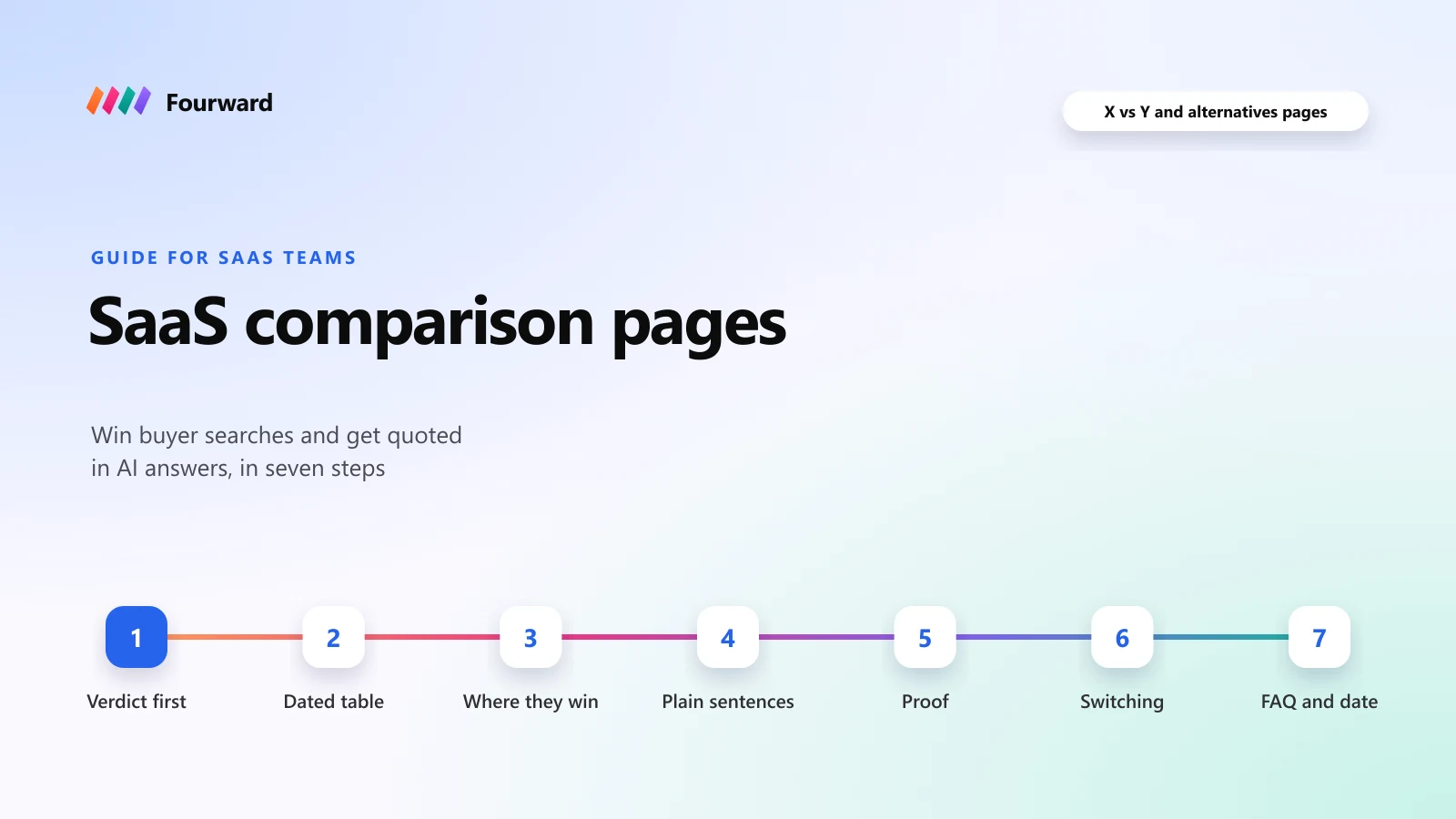
A good comparison page answers the buyer's question in the first screen, then backs it up. These seven steps are in the order the reader meets them.
1. Open with a short verdict
Write two or three sentences that say who each product suits. For example: "Pick us if your team needs live chat and phone in one inbox. Pick them if you only answer email." A buyer should not have to scroll to learn your view.
2. Add a side-by-side table with dated facts
Microsoft's guidance on AI search says "Bulleted lists, numbered steps, and comparison tables break complex details into clean, reusable segments." Use the same rows for both products:
- Entry price, with the unit, such as per user a month, billed annually.
- What each plan includes, and the main limits.
- Key integrations, named one by one.
- Support and contract terms, such as monthly or annual billing.
Link every competitor fact to the competitor's own page, and show the date you checked it.
3. Say where the competitor is the better pick
Google's guidance on writing reviews asks writers to "Discuss the benefits and drawbacks" of a product. The same guidance asks writers to "explain which might be best for certain uses or circumstances". A page that only praises you reads like an advert, to buyers and to AI tools.
4. Write the key facts as plain sentences
Microsoft's advice is to "Make answers snippable: Use concise, self-contained phrasing in lists, Q&As, and tables." A self-contained sentence makes sense when it is copied out alone. "[Product] starts at [price] per user a month, billed annually" can be quoted. "Flexible plans for every team" cannot.
5. Show proof, not adjectives
Google asks for "evidence such as visuals, audio, or other links of your own experience". Microsoft says "Avoid vague language." In practice, that means:
- Screenshots of both products doing the same task.
- Quotes from customers who switched, with their name and company if they agree.
- Links to your pricing page, docs and integration pages.
6. Explain how switching works
A buyer comparing two tools often already uses one of them. Say what data moves across, what has to be rebuilt, and who helps with the move. If you offer migration help or an import tool, name it.
7. End with a FAQ and a visible date
Add four to six questions buyers ask your sales team, each with a short answer. Put a "last checked" date near the table. Update the page when either product changes its prices or plans.
Free check. 75 checks, one score out of 100, under a minute.
How to get comparison pages quoted in AI answers
Google says "There are no additional requirements to appear in AI Overviews or AI Mode, nor other special optimizations necessary." So the work is ordinary search work, done well on the pages buyers compare with.
- Get the page indexed. Google says a page "must be indexed and eligible to be shown" with a snippet to appear as a supporting link in AI Overviews or AI Mode. Use URL Inspection in Search Console to check.
- Let AI crawlers in. An AI crawler is the bot an AI company uses to read web pages. A robots.txt rule or a firewall setting can block it without anyone noticing. Our free AI crawler checker tests 20 AI crawlers against both.
- Keep facts in text. Prices shown only in an image, or hidden behind a tab that needs a click, are harder for any bot to read.
- Make your facts match everywhere. If your pricing page, comparison page and directory listings disagree, an AI answer may repeat the wrong one.
- Earn mentions on other sites. Query fan-out pulls in many sources, not only yours. Third-party comparisons and "best X" lists are part of what those searches find.
GEO (generative engine optimization) means making your site easy for AI answers to find, read and quote. Our GEO guide for B2B SaaS covers this wider work. For ChatGPT in particular, see our guide on how to get cited by ChatGPT.
Examples of SaaS comparison pages
Two large SaaS companies show the pattern well. Both pages were written by one side, so read them as marketing, but the structure is worth copying.
HubSpot vs Pipedrive
- A section of its own. HubSpot's page sits in a /comparisons/ section of its site, not in the blog.
- A side-by-side grid of features for both products.
- Credit for the rival. HubSpot's page says "Pipedrive is a capable pipeline management tool".
- Switching in the FAQ. One question asks "What's the process for moving to HubSpot?"
Zendesk vs Freshdesk
- A dated title and dated prices. Zendesk's page puts 2026 in its title and says "Pricing verified October 2026".
- A best-fit line for each product. For Freshdesk, the page says: "Teams focused on email ticketing, with a separate omnichannel offering (Freshdesk Omni) for other channels."
- Honest on price where it is even. Zendesk's page states plainly: "Entry plans are both $19."
- At-a-glance and pricing tables, plus a FAQ.
A third-party comparison follows the same rules from the outside. Our Semrush vs Ahrefs comparison takes every number from each company's own pages.
Common comparison page mistakes
- Claims you cannot back up. The FTC's policy statement says "The Commission evaluates comparative advertising in the same manner as it evaluates all other advertising techniques." Keep a source for every claim, and ask a lawyer about your own market, especially outside the US.
- Old competitor prices. Competitors change plans often. An out-of-date price on your page can end up in an AI answer.
- Attacking the competitor. Buyers who use the other tool will read your page. Mocking it makes you look worse, not them.
- Praise with no trade-offs. If your page never names a case where the other product wins, readers stop trusting the rest of it.
- Facts locked in images. A table saved as a picture is hard to quote, search or read with a screen reader.
- Thin pages for every rival. A page for a competitor nobody compares you with has little to say. Build fewer pages and keep them current.
A full SEO, AEO and GEO audit, plus 30 minutes with our team to walk you through it.
Related: SaaS competitive pricing strategy: how to benchmark rivals and win the comparison.
FAQs
What is a SaaS comparison page?
A SaaS comparison page is a page on a SaaS company's own site that compares its product with one or more named competitors. The most common forms are "X vs Y" pages and "X alternatives" pages, written for buyers who are close to choosing.
Should a comparison page say where the competitor is better?
Yes. Google's guidance for review content asks writers to cover benefits and drawbacks, and which option suits which use. A fair page earns more trust from buyers and gives AI answers a balanced source.
Is it legal to name competitors on a comparison page?
In the US, the FTC says its policy encourages naming competitors, and it calls truthful, non-deceptive comparative advertising a source of important information. Rules differ by country, so check with a lawyer before you publish.
How many comparison pages should a SaaS company have?
Start with one "X vs Y" page for the competitor you meet most and one alternatives page. Add more when sales calls or search data show buyers comparing you with another product.
Do comparison pages help you get cited in AI answers?
They can, because AI tools run narrow follow-up searches, and comparisons are among the narrowest. Google says its AI features need no special optimization, but a page must be indexed and eligible for a snippet to be a supporting link.
Sources
- AI features and your website, Google Search Central, checked 15 November 2026.
- Write high quality reviews, Google Search Central, checked 15 November 2026.
- Optimizing Your Content for Inclusion in AI Search Answers, Microsoft Advertising, 8 October 2025, checked 15 November 2026.
- Statement of Policy Regarding Comparative Advertising, Federal Trade Commission, 13 August 1979, checked 15 November 2026.
- New G2 Research: AI Is Reshaping How B2B Software Deals Are Won and Lost, G2, 22 July 2026, checked 15 November 2026.
- HubSpot vs Pipedrive, HubSpot, checked 15 November 2026.
- Zendesk vs. Freshdesk: Which platform scales better? (2026), Zendesk, checked 15 November 2026.