
On this page
SaaS demand generation is the marketing that makes the right buyers aware of a problem and of your product, then turns that interest into sales conversations. In practice, a B2B SaaS team runs a few channels, such as content, LinkedIn, webinars, email and sales assets, so that each one feeds the next. You can see it working before pipeline shows up, through signals like branded search and engagement from target accounts.
This guide covers what demand generation means for a SaaS team, the channels, how they connect, what to measure first, what it costs and the mistakes to avoid.
I lead lifecycle and demand generation at Fourward. My work covers HubSpot and CRM (customer relationship management) set-up, nurture emails, webinars, account-based marketing and gated content, so I have a stake in this topic. Every number below comes from the publisher's own page, checked on 25 November 2026.
- SaaS demand generation is the marketing that creates interest among the buyers you want and turns it into sales conversations, including buyers who are not shopping yet.
- LinkedIn's B2B Institute says 95% of potential buyers are not ready to buy today, so most demand generation work reaches people who will buy later.
- In a 6sense survey of nearly 4,000 B2B buyers, four out of five deals went to the vendor the buyer already favoured before first contact.
- The channels work as a chain: content feeds posts and ads, ads fill webinars, webinars feed nurture emails, and nurture feeds sales.
- Before pipeline arrives, watch branded search, engagement from target accounts and what new leads say brought them.
What demand generation means for a SaaS team
The term gets used in two ways. In the narrow sense, as in our guide to B2B brand building, demand generation is the short-term ask to buyers who are ready now. In a SaaS job title, it usually means the whole path from first interest to a booked sales call.
This guide uses the wider meaning, which has two halves.
- Demand creation makes buyers aware of a problem and of you as a way to solve it. Content, LinkedIn posts, webinars and podcasts do this work.
- Demand capture catches buyers who are already looking. Search ads, comparison pages, the pricing page and the demo form do this work.
Demand generation vs lead generation
Lead generation collects contact details, such as a form fill or an ebook download. Demand generation creates the reason someone fills in the form, or books a demo with no form at all. A team can hit its lead target and still have no pipeline, because a download is not a buying signal on its own.
Why most of your market is not buying yet
Demand generation exists because buyers are rarely ready when you first reach them. Two pieces of research show the size of the gap.
- Most buyers are between purchases. LinkedIn's B2B Institute says "95% of your potential buyers aren’t ready to buy today". Its reason: "The time between purchases for many B2B goods and services is quite long."
- Buyers choose before they call. 6sense surveyed nearly 4,000 B2B buyers for its 2025 report. Buyers first contacted a seller 61% of the way through their journey, down from 69%. Four out of five deals went to the "pre-contact favorite".
So the job is to be remembered before the buying starts. The B2B Institute's advice: "Your job as a marketer is to start linking your brand to relevant buying situations". This is also why lead counts alone tell you little in the early months.
The channels in a SaaS demand generation program
You do not need every channel. You need a few that each do one clear job, and a way to pass buyers between them. These are the usual ones for a B2B SaaS team.
| Channel | Its job | Early sign it is working |
|---|---|---|
| Search content and AI answers | Be found when buyers research the problem or compare tools | More impressions on non-branded searches, then more branded ones |
| LinkedIn ads and founder posts | Put your point of view in front of target accounts | More engagement from the companies on your list |
| Webinars and events | Turn attention into named people you can talk to | Sign-ups from target accounts and questions asked live |
| Gated content and free tools | Trade something useful for a contact | Sign-ups that match your ideal customer profile |
| Email nurture | Stay useful until the buyer is ready | Replies and demo requests from nurtured contacts |
| Account-based marketing | Focus the channels above on a named list of companies | Several people from one company engaging |
| Sales assets | Help a buyer make the case inside their company | Assets requested or forwarded in live deals |
Which channels to start with
Start where your buyers already spend time, and where you can keep up the effort every week. With a small team, I would pick three:
- One owned channel that compounds, usually search content, because a good page keeps bringing readers long after you publish it.
- One paid channel that reaches named accounts, usually LinkedIn, because you can target by company and job title.
- One channel that turns attention into conversations, usually a webinar series, because people who show up live are easier to follow up with.
Email nurture and sales assets sit under all three, because every channel produces contacts who need follow-up.
Search now includes AI answers
Buyers also ask AI assistants such as ChatGPT which tools to shortlist. Those answers draw on pages the assistant can read. Fourward's free AI visibility check runs 75 checks on what AI engines can read about your site.
How the channels feed each other
Channels run as separate projects give separate, small results. Demand generation works when each channel hands buyers and material to the next. This is the order I build it in.
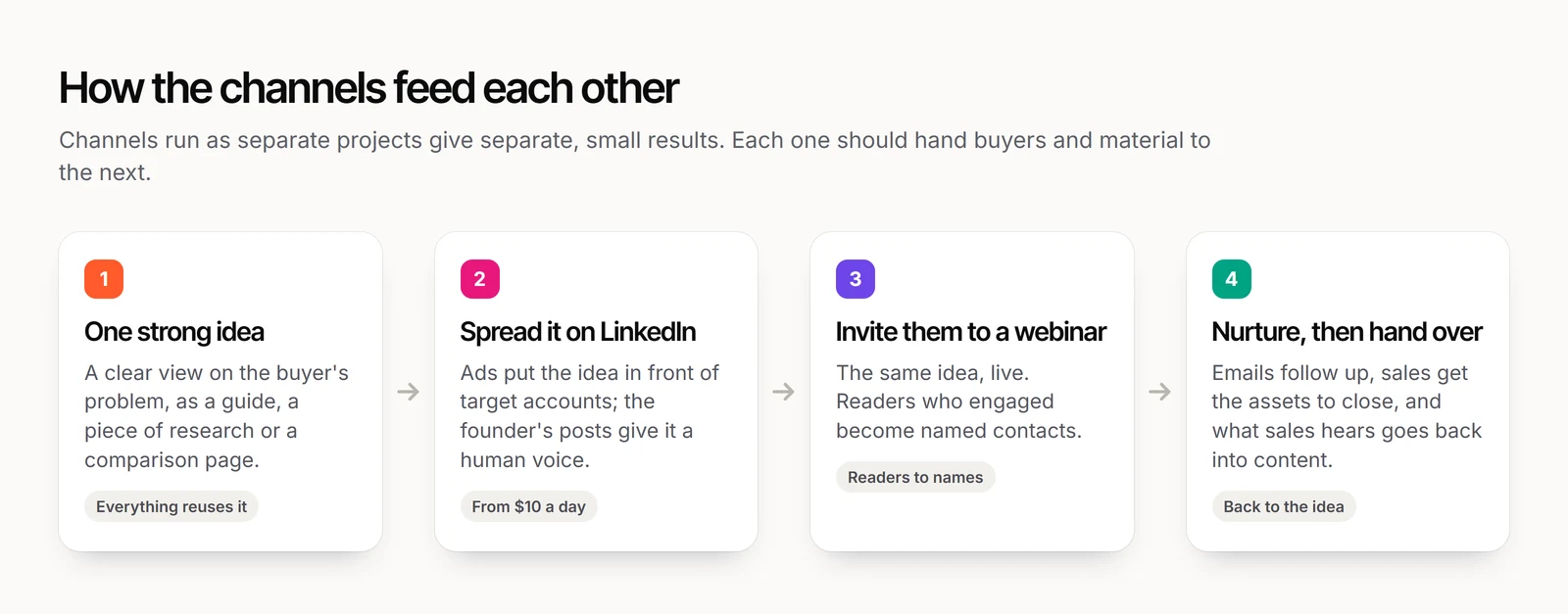
- Start with one strong idea. Write down a clear view on the buyer's problem, as a guide, a piece of research or a comparison page. Every later step reuses it.
- Spread it on LinkedIn. Ads put the idea in front of target accounts, and the founder's posts give it a human voice. LinkedIn's minimum daily budget is $10, so a small test is possible.
- Invite the people who engaged to a webinar. A webinar on the same idea turns readers into named contacts. The recording and the live questions become new posts and clips.
- Follow up with nurture emails. Attendees and no-shows enter a sequence that changes with what they do. I cover the stages and triggers in my guide to B2B lead nurturing.
- Give sales the assets to close. Your champion is the person inside the account who wants to buy. A one-page business case, a comparison or a customer case study helps them sell internally.
- Feed what sales hears back into content. Questions from sales calls become the next guide, comparison page or webinar topic, and the loop starts again.
The gain is reuse. One webinar can supply social posts, nurture emails and a sales asset, so each extra channel costs less to run.
Free check. 75 checks, one score out of 100, under a minute.
What to measure before pipeline arrives
Pipeline is the result you want, but it trails the work by at least one sales cycle. Early signals tell you whether the work reaches the right people in the meantime.
| Signal | What it tells you | Where to find it |
|---|---|---|
| Branded search | More people know your name and look it up | Google Search Console, branded queries filter |
| Target-account engagement | Your posts and ads reach the companies you want | LinkedIn Campaign Manager, Companies Hub |
| Self-reported source | Where buyers say they heard of you, including podcasts and word of mouth | A free-text field on the demo form |
| Replies and demos from nurture | Follow-up moves people towards sales | Your CRM |
| Pipeline and win rate from target accounts | Whether the program pays | CRM attribution reports |
Branded search
Branded search means people typing your company or product name into Google. When it rises, more buyers remember you. Google added a branded queries filter to Search Console on 20 November 2025. The filter splits your query data into "two distinct views", branded and non-branded. The filter counts "brand-related products or services" as branded too, and needs "a sufficient volume of queries and impressions".
Engagement from target accounts
Account-based marketing (ABM) means marketing aimed at a named list of companies. If you run it, watch whether those companies engage. LinkedIn's Companies Hub in Campaign Manager shows "engagement level, organic engagements, leads, revenue won, and paid clicks" by company. Intent data adds signals from outside your own channels, as I cover in B2B intent data best practices.
What buyers say brought them
Add a required free-text question to the demo form that asks how the buyer heard about you. Buyers can name a podcast, a LinkedIn post or a colleague, which click tracking cannot see. Read the answers every week and tag each one by channel.
Attribution in your CRM
Your CRM can show which touches came before a deal. HubSpot's help centre says: "Use attribution reporting to see the interactions that your contacts have along their customer journey". HubSpot's deal and revenue attribution reports are for "Marketing Hub Enterprise accounts only". Smaller teams can rely on the first three signals until then.
What SaaS demand generation costs to start
The cost has three parts: ad spend, software and people's time. Here are the published floors for the first two, plus one guide for splitting the budget.
- LinkedIn ads. LinkedIn's budget guide says the minimum daily budget "is $10 USD, for any ad format". The minimum lifetime budget for a new campaign is $100.
- Marketing automation. HubSpot lists Marketing Hub Professional from $800 a month. It adds a required one-time onboarding fee of $3,000. You can start with the CRM you already have and upgrade later.
- Brand versus activation. Activation means marketing that asks for an immediate response, such as a demo request. A 2019 LinkedIn article on B2B effectiveness research put the best split at "46% of budget to brand-building activity and 54% to activation marketing". Treat it as a starting guide, not a rule.
Time is usually the largest cost. A webinar series and a steady flow of content each need an owner every week.
Common SaaS demand generation mistakes
- Counting downloads as demand. An ebook download shows interest in a topic, not in buying. Send it to nurture, not straight to sales.
- Gating every asset. Ideas spread when people can read them freely. Gate the deep material, such as a template or a benchmark, and keep the thinking open.
- Running each channel alone. If the webinar team never tells the content team what buyers asked, both teams repeat work and miss the best topics.
- Judging too early. Pipeline trails the work by a sales cycle or more. Judge the first months on the early signals above.
- Cutting brand work when pipeline dips. The 95% who are not buying today are where future pipeline comes from. Cutting their exposure shrinks it.
- Measuring opens instead of actions. Email opens are easy to count and easy to misread. Replies, demo requests and meetings tell you more.
A full SEO, AEO and GEO audit, plus 30 minutes with our team to walk you through it.
FAQs
What is demand generation in SaaS?
SaaS demand generation is the marketing that makes the right buyers aware of a problem and of your product, then turns that interest into sales conversations. It covers demand creation, such as content and webinars, and demand capture, such as search ads and the demo form.
What is the difference between demand generation and lead generation?
Lead generation collects contact details, such as a form fill. Demand generation creates the reason a buyer wants to talk to you, so the leads that arrive are more likely to buy.
Which channels work best for B2B SaaS demand generation?
No single channel works best on its own. A common mix is search content, LinkedIn ads and posts, webinars, email nurture and sales assets. The gain comes from each one feeding the next.
How long does demand generation take to show results?
Pipeline usually trails the work by at least one sales cycle. Early signals, such as branded search and engagement from target accounts, can move sooner.
How do you measure demand generation before pipeline arrives?
Watch branded search in Google Search Console, engagement from target accounts in LinkedIn's Companies Hub, and what buyers write in a "How did you hear about us?" field. Then check replies and demo requests from nurtured contacts.
Sources
- 95-5 Rule, LinkedIn B2B Institute, checked 25 November 2026.
- The B2B Buyer Experience Report for 2025, 6sense, checked 25 November 2026.
- Introducing the branded queries filter in Search Console, Google Search Central, 20 November 2025, checked 25 November 2026.
- Get started with Companies Hub in Campaign Manager, LinkedIn Marketing Solutions Help, checked 25 November 2026.
- Create attribution reports, HubSpot Knowledge Base, updated 18 August 2026, checked 25 November 2026.
- How to set LinkedIn ad budgets: Daily, lifetime, and Dynamic Group Budget explained, LinkedIn, checked 25 November 2026.
- Marketing Software Pricing, HubSpot, checked 25 November 2026.
- How B2B marketing really drives growth, LinkedIn Marketing Blog, 16 October 2019, checked 25 November 2026.