
On this page
B2B brand building is the long-term work of making your company easy to remember and easy to describe, so buyers think of you first when a need comes up. For a SaaS company in 2026, it also means ChatGPT and Google's AI answers name you when a buyer asks for options. You get there with one clear category, the same facts about you everywhere, and steady mentions on the sites buyers and AI tools already read.
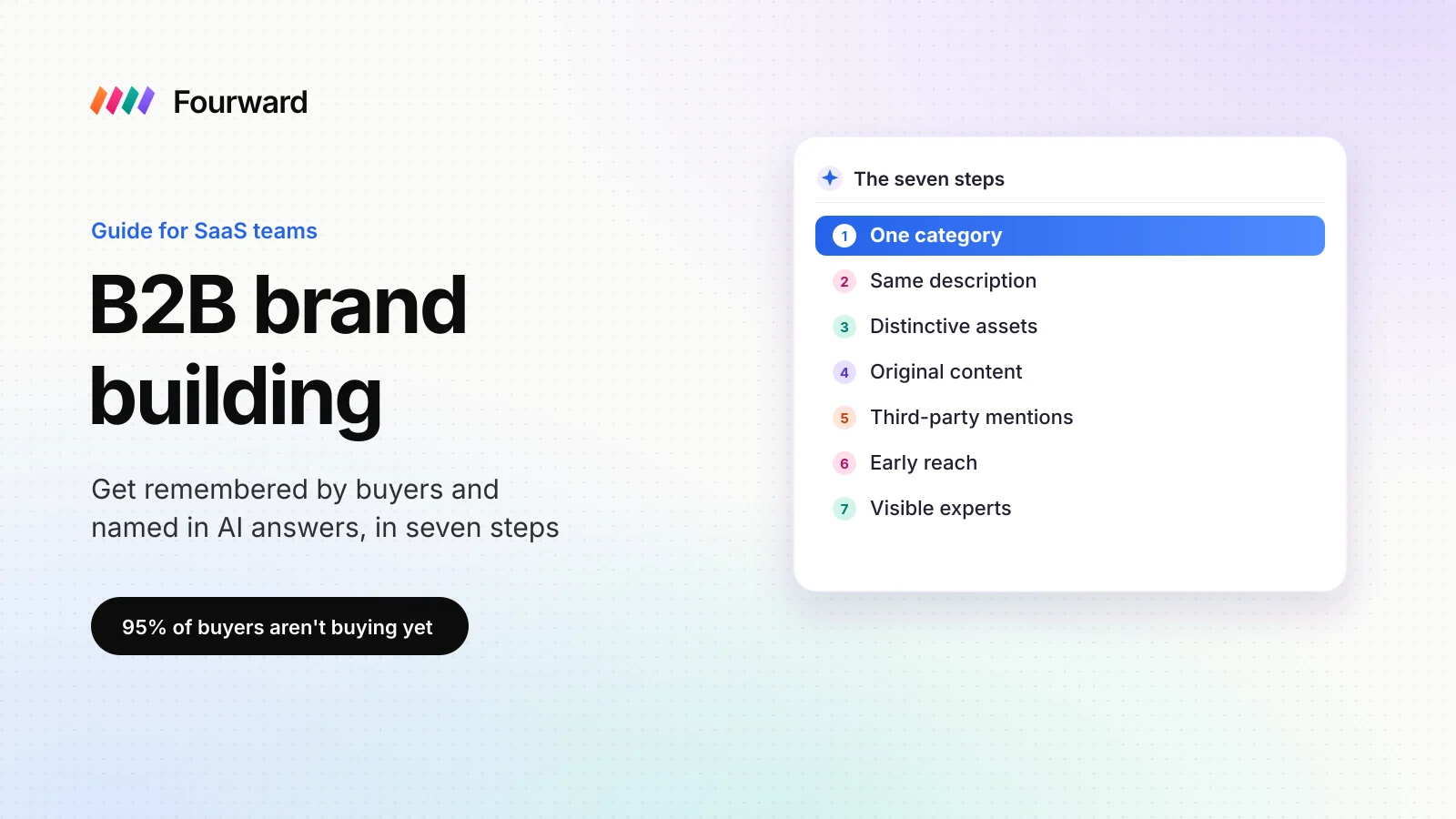
This guide covers what brand building is, why it matters, seven steps, how much to spend and how to measure it.
I lead search, content and AI visibility at Fourward, and our team also works on brand, PR (public relations) and partnerships, so I have a stake in this topic. Every number below comes from the publisher's own page, checked on 9 November 2026.
- B2B brand building is making your company easy to remember and easy to describe, so buyers and AI answers name it when a need comes up.
- LinkedIn's B2B Institute says 95% of potential buyers are not ready to buy today. Brand work reaches them before they start looking.
- In a 6sense survey of 4,611 B2B buyers, the vendor they favoured before contacting sales won 82% of the time.
- Ahrefs found that brand mentions on other websites track AI Overview visibility far more closely than backlinks do.
- Binet and Field's B2B research advises a 50/50 budget split between long-term brand building and short-term sales activation.
What B2B brand building is
A brand is what buyers remember and believe about your company when you are not in the room. B2B brand building is the planned work of shaping that memory, so the right buyers think of you and describe you correctly.
The B2B Institute, LinkedIn's research group, wrote its How B2B Brands Grow papers with the Ehrenberg-Bass Institute, a marketing science research centre. The papers sum up marketing's job as making your brand "easy to mind and easy to find".
Brand building versus demand generation
Demand generation asks buyers who are ready now to act, for example by booking a demo. Brand building works on the much larger group who will buy later. Most SaaS teams need both.
| Brand building | Demand generation | |
|---|---|---|
| Who it reaches | Everyone in your category, including people not buying yet | Buyers who are looking now |
| Goal | Be remembered and described correctly | Get a demo, trial or sign-up |
| Typical work | Positioning, content, PR, brand ads, expert posts | Search ads, retargeting, offers, outbound email |
| When it pays back | Over months and years | Within weeks |
| How you measure it | Branded search, share of search, AI mentions | Leads, sales pipeline, cost per demo |
What changes for SaaS in 2026
Buyers can now ask an AI assistant for a shortlist before they visit a single vendor site. An AI answer is the reply that ChatGPT, Perplexity, Gemini or Google's AI Overviews give to a question. These tools can only name brands they have read about, so brand building now includes being described well on the pages they read. GEO (generative engine optimization) is the name for that work, and our GEO guide for B2B SaaS covers the technical side.
Why brand building matters for SaaS buyers and AI answers
Three findings explain why brand work pays off, even for a small SaaS team.
Most buyers are not buying yet
The B2B Institute's 95-5 rule says "95% of your potential buyers aren’t ready to buy today". The institute's advice is to advertise mostly to people who are not likely to buy from you today. Its reason: "the brand that is most easily remembered is the brand that gets bought".
Buyers pick a favourite before they call you
6sense, a company that sells sales and marketing software, surveyed 4,611 recent B2B buyers for its 2026 report. The vendor that buyers favoured before contacting a seller won 82% of the time. In the same survey, 92% of eventual winners were on the first shortlist.
Many deals are decided by what buyers remember before your sales team speaks to them. These are one vendor's survey numbers, but they point the same way as the 95-5 rule.
AI answers repeat what the web says about you
Ahrefs, an SEO tool company, studied 75,000 brands to see what goes with being named in AI Overviews. AI Overviews are the AI summaries at the top of Google results. Brand mentions on other websites scored 0.664, and backlinks (links from other sites to yours) scored 0.218, on a correlation scale where higher means a closer match.
Ahrefs' result is a correlation, not proof that mentions cause visibility. Ahrefs' November 2026 citation data says ChatGPT "pulls from a relatively small set of trusted sources", led by Wikipedia at 10.1% of citations and Reddit at 6.2%.
The seven steps at a glance
| Step | What it gives you | Main cost |
|---|---|---|
| 1. Own one category and one sentence | Buyers and AI tools describe you the same way | A few workshops and some hard choices |
| 2. Describe your company the same way everywhere | Search engines and AI tools find matching facts about you | Admin time and a little developer time |
| 3. Pick distinctive brand assets and keep them | Buyers recognise you before they read your name | Design time, then discipline |
| 4. Publish things only you can say | Other sites quote you, with your name attached | Research and writing time |
| 5. Get named where buyers and AI already look | Mentions on the sources AI answers draw on | Outreach and PR time |
| 6. Reach buyers before they are in market | Your name is familiar when the need comes | Paid reach and content budget |
| 7. Let your experts be seen | Buyers hear useful ideas next to your name | Your experts' time each week |
How to build a B2B brand in seven steps
The order of these steps matters. Steps 1 and 2 decide what everyone will repeat about you, so settle them before you spend money on reach.
1. Own one category and one sentence
Buyers remember a company by the problem it solves and the category it sits in. Pick one category, in the words buyers use, and write one sentence that a stranger could repeat.
- Who it is for: the role and company type, such as finance teams at mid-sized companies.
- What it does: the job it does, in plain words, not a slogan.
- How it differs: one difference you can prove with a fact.
Test the sentence on a handful of customers. If they describe you differently, use their words, because those are the words other buyers will search with.
2. Describe your company the same way everywhere
Search engines and AI tools build their picture of you from many pages, not only your homepage. If your site says "revenue platform" and your review profiles say "sales tool", that picture gets blurred.
- Use your one sentence everywhere. Put it on your homepage, About page, LinkedIn page, review profiles, partner listings and the company paragraph at the end of your press releases.
- Add Organization structured data to your homepage. Structured data is code that labels facts for search engines. Google says it can help it "disambiguate your organization in search results", which means tell you apart from similar names.
- Fill in the sameAs property. Google defines it as "The URL of a page on another website with additional information about your organization, if applicable". List your official profiles there.
3. Pick distinctive brand assets and keep them
Distinctive brand assets are the things people link to you without reading your name: a colour, a logo, a shape, a phrase or a voice. These assets help a busy buyer spot you quickly in a crowded feed.
Pick a small set and use them the same way for years. Your team sees them every day and gets bored of them. A buyer may see them only a few times a year, so every change makes that buyer start learning again.
4. Publish things only you can say
Generic advice gets read and forgotten. Content that only your company could produce gets quoted, and every quote puts your name on someone else's page.
- Data from your product, shared as totals or averages with no customer named, such as typical setup times or usage patterns.
- A yearly survey of your buyers, with the method published next to the results.
- Clear opinions from your founder on where the category is going and why.
- Honest comparisons with the tools buyers already know, including where the other tool is better.
5. Get named where buyers and AI already look
Your own website cannot earn these mentions for you. AI answers draw heavily on what other sites say about you, as the Ahrefs data above suggests.
- Review sites your buyers use. Keep your listing, features and pricing current.
- "Best X" lists and comparison posts that already rank for your category. Ask the authors to include you, with facts, not a pitch.
- Reddit and community threads where buyers ask for advice. Answer as yourself and say where you work.
- Trade press and podcasts your buyers follow. My list of digital PR agencies covers firms that do this work.
To find the right sites, ask ChatGPT your top buyer questions and note every source it cites. My guide on how to get cited by ChatGPT covers the rest of that work.
6. Reach buyers before they are in market
"In market" means actively looking to buy. The 95-5 rule says most of your future buyers are not, so reaching only today's searchers misses most of them.
- Pick channels with broad reach in your category, such as LinkedIn, industry newsletters, podcasts and events.
- Show your name and assets early in every ad and video, so people remember who it came from.
- Keep a steady presence all year, instead of one big launch followed by silence.
7. Let your experts be seen
Your experts can reach buyers that company pages do not. A founder or specialist who posts on LinkedIn, speaks on podcasts and gets quoted in the press puts your company name next to useful ideas.
Give each expert your one sentence for their profile. Then let them write in their own voice, about problems they know well.
Free check. 30 checks, one score out of 100, under a minute.
How much to spend on brand versus demand
The best-known guidance comes from Les Binet and Peter Field, two researchers who study which advertising works. Their B2B research says brands "should balance the budget between long-term brand building and short-term sales activation with a 50/50 split".
Sales activation means marketing that asks for an action now, such as search ads, demo offers and retargeting (ads shown to people who already visited your site). Treat the 50/50 split as a starting point, then adjust it to your stage.
- Early stage, few customers: spend little on paid brand reach. Do steps 1, 2 and 7 first, because they cost mostly time.
- Growing: move toward the 50/50 split as you learn which channels bring in deals.
- Established: protect the brand budget when you need quick leads. Cuts to brand spending show up in results later, not this quarter.
How to measure B2B brand building
Brand work rarely shows up in last-click reports, which credit only the final ad or page before a sign-up. Track these signals each month and judge the trend over quarters.
| Signal | What it tells you | Where to find it |
|---|---|---|
| Branded search | More people look for you by name | Google Search Console, branded queries filter |
| Share of search | Your share of the brand searches in your category | Google Trends, compared with competitors |
| AI answer mentions | Whether AI tools name you and describe you correctly | Monthly prompt checks or an AI visibility tool |
| Self-reported source | Where buyers say they first heard of you | A free-text field on your demo form |
Branded search in Google Search Console
Google Search Console is Google's free report on how your site performs in search. In November 2025, Google added a branded queries filter to Search Console. Google's definition: "A branded query is a query that includes your brand name". The filter needs enough search data, so very small sites may not see it yet.
Share of search
Share of search is your brand's searches as a share of all brand searches in your category. The IPA (Institute of Practitioners in Advertising) hosts Les Binet's work on branded share of search "as a way to predict market share". You can compare your name with competitors' names in Google Trends, Google's free tool for search interest.
Mentions in AI answers
Once a month, ask ChatGPT, Perplexity, Gemini and Google the questions your buyers ask. Record whether you are named, how you are described and which sources are cited. When you track many questions, an AI visibility tool runs them for you.
If AI tools skip you, check that they can read your site at all. I built Fourward's free AI visibility check, which runs 30 checks on what AI engines can read about a site.
What buyers tell you
Add a free-text "How did you hear about us?" field to your demo form. Buyers may name a podcast, a post or a colleague that no tracking tool recorded.
Common B2B brand building mistakes
- Treating brand as a logo project. A new logo without a clear category and sentence changes little that buyers remember.
- Changing the message every quarter. Each change makes buyers and AI tools relearn who you are.
- Only targeting buyers who are ready now. The 95-5 rule says that group is small at any moment.
- Describing yourself differently on every site. AI answers can then repeat the wrong description.
- Judging brand by last-click leads. Brand work shows up in branded search, AI mentions and win rates over quarters, not in this week's report.
A full SEO, AEO and GEO audit, plus 30 minutes with our team to walk you through it.
FAQs
What is B2B brand building?
B2B brand building is the long-term work of making your company easy to remember and easy to describe, so the right buyers think of you when a need comes up. It covers positioning, consistent descriptions, original content, PR, brand ads and visible experts.
How long does B2B brand building take?
There is no fixed timeline. Brand work builds memory over months and years, so judge it on quarterly trends in branded search, share of search and AI mentions, not on weekly leads.
How much of a B2B marketing budget should go to brand?
Les Binet and Peter Field's research for LinkedIn's B2B Institute advises a 50/50 split between long-term brand building and short-term sales activation. Early-stage teams can start with the steps that cost mostly time, such as positioning and founder visibility.
How do you get AI assistants to mention your brand?
Describe your company the same way everywhere, make sure AI tools can read your site, and get mentioned on the sites AI answers draw on, such as review sites, comparison posts, Reddit and trade press. Ahrefs found brand web mentions track AI Overview visibility far more closely than backlinks.
How do you measure B2B brand awareness?
Track branded search in Google Search Console, your share of search against competitors in Google Trends, how often AI answers name you, and where buyers say they heard of you. Judge the trend across quarters, not single months.
Sources
- 95-5 Rule, LinkedIn B2B Institute, checked 9 November 2026.
- The 5 Principles Of Growth In B2B Marketing, LinkedIn B2B Institute, research by Les Binet and Peter Field, checked 9 November 2026.
- How B2B Brands Grow, LinkedIn B2B Institute with the Ehrenberg-Bass Institute, checked 9 November 2026.
- 6sense Research Finds That Vendors Need to Be Known and Preferred Before the Buying Journey Begins, 6sense, 2 November 2026, checked 9 November 2026.
- An Analysis of AI Overview Brand Visibility Factors (75K Brands Studied), Ahrefs, 26 May 2025, checked 9 November 2026.
- The 50 Most-Cited Websites in ChatGPT (November 2026), Ahrefs, updated 3 November 2026, checked 9 November 2026.
- Organization structured data, Google Search Central, checked 9 November 2026.
- Introducing the branded queries filter in Search Console, Google Search Central, 20 November 2025, checked 9 November 2026.
- Share of Search, IPA, last updated 6 March 2025, checked 9 November 2026.