
On this page
To write a business case study, pick one customer who looks like your buyers, agree the before and after numbers, and interview them. Write the story as problem, choice, rollout and result, with a one-sentence summary of the main result at the top. Give every claim a name, a unit, a time frame and a source, so buyers can trust it and AI answers can quote it.
This guide covers what a case study is, why it matters now that buyers ask AI tools, eight steps with a template, and the mistakes that cost trust.
I lead search, content and AI visibility at Fourward, and I have been writing and ranking B2B content since 2020. Every number and quote below links to the publisher's own page, checked on 13 November 2026.
- A business case study is a short, factual story of how one named customer solved one problem with your product, with numbers from before and after.
- In G2's 2026 survey, 51% of B2B software buyers start research with an AI chatbot more often than with Google. Your case study often has to convince them before you meet.
- A 2024 research paper on GEO (generative engine optimization) found its best methods were citing sources, adding quotations and adding statistics. A case study holds all three.
- Write the summary first: customer, problem, product, result and time frame in one sentence that a buyer or an AI tool can quote as it is.
- The FTC (Federal Trade Commission) says endorsements must be honest, and a connection that could change how readers judge a quote, such as a discount, should be disclosed clearly.
What a business case study is
A business case study is a short story about one real customer: the problem they had, why they chose you, what they did and what changed. In B2B SaaS (software sold to businesses as a subscription), people also call it a customer story or a success story.
Three things people mean by "business case study"
- Customer case study. A marketing page that shows how a customer got a result with your product. This guide is about this kind.
- Teaching case. A business school case that describes a company's decision and leaves the answer to the class.
- Business case. An internal document that argues for a project or a purchase, with its costs and expected returns.
A good customer case study reads like evidence, not like an advert. Google's guidance on helpful content asks whether a page provides "original information, reporting, research, or analysis". A case study is one of the few pages where only you have that information.
Why case studies matter more when buyers ask AI
Buyers now read about you before they talk to you, and often through an AI tool. Three findings show why the case study carries more weight than before.
- AI comes first. G2, a software review site, says in its 2026 AI Search Insight Report: "51% start their research with an AI chatbot more often than Google."
- Buyers check the sources. The same report says 45% of B2B software buyers rate review site citations as "the most confidence-inspiring signal in an AI answer".
- Numbers and quotes help. The 2024 GEO research paper tested ways to make pages show up more in AI answers. Its top methods were Cite Sources, Quotation Addition and Statistics Addition, and it says GEO "can boost visibility by up to 40% in generative engine responses".
The paper also warns that "the efficacy of these strategies varies across domains", so treat 40% as a best case from controlled tests, not a promise. Still, a case study already holds a named source, a customer quote and a number. Our GEO guide for B2B SaaS covers the wider site work.
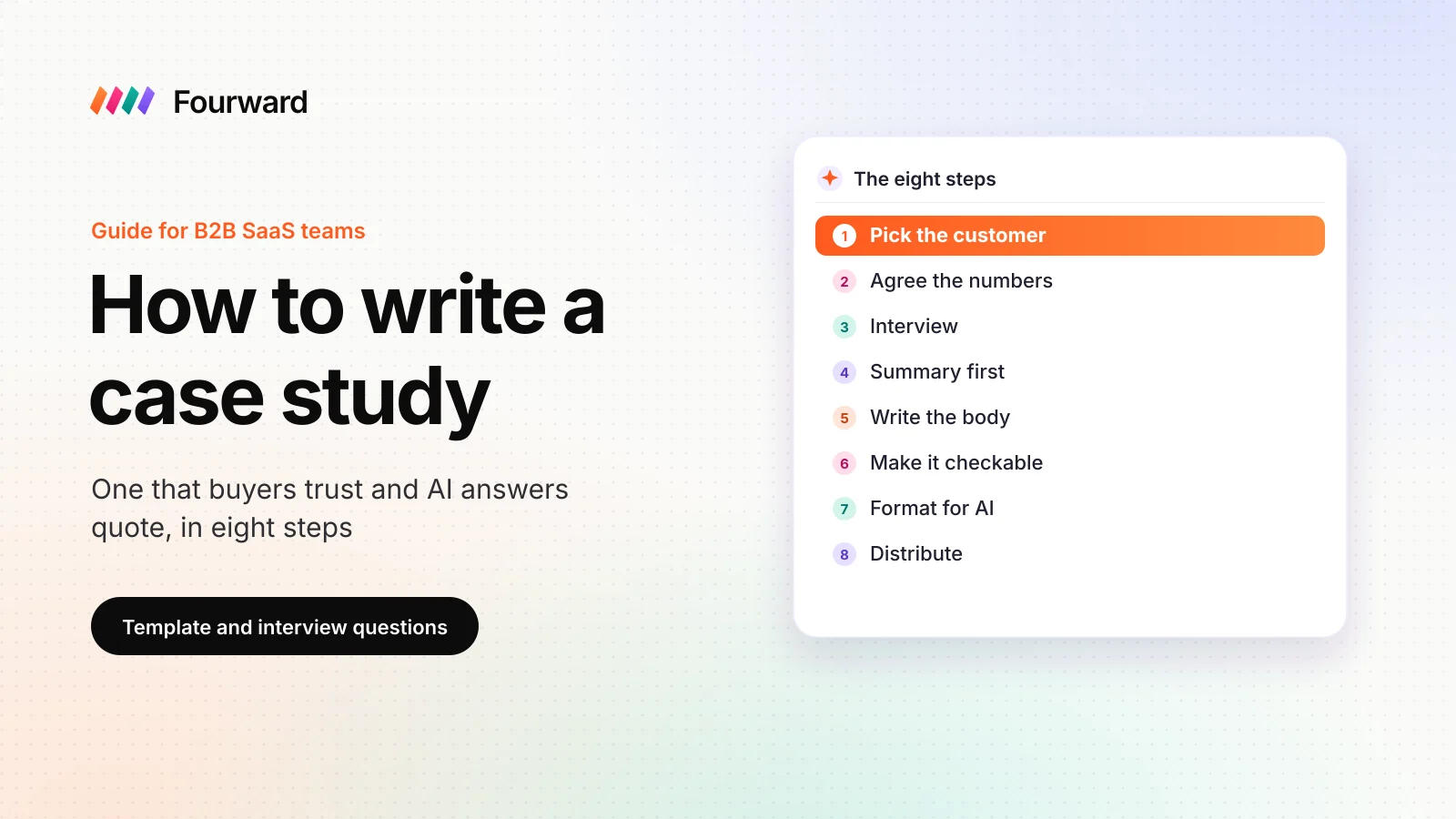
The eight steps at a glance
| Step | What you do | Why it matters |
|---|---|---|
| 1. Pick the customer | Choose one who looks like your target buyers and will be named | Buyers trust stories from companies like theirs |
| 2. Agree the numbers | Fix the metric, baseline, time frame and data source | A result without a starting point proves nothing |
| 3. Interview the customer | One recorded call, with their permission | Real quotes are what buyers and AI tools repeat |
| 4. Write the summary first | One sentence with customer, problem, product, result and time | It is the line sales pastes and AI tools quote |
| 5. Write the body | Challenge, choice, rollout, results, next steps | A fixed order is easy to skim |
| 6. Make claims checkable | Names, units, sources and disclosures | Trust, and the FTC's endorsement rules |
| 7. Format it for AI answers | A web page, a clear title, numbers in text | AI tools can only quote what they can read |
| 8. Put it where buyers look | Link it from key pages, give it to sales, ask for a review | A story nobody finds does nothing |
1. Pick a customer your buyers recognise
The best case study is about a customer your next buyer sees as a peer. A buyer at a small logistics firm will skim past a story about a global bank.
- Match the deals you want. Pick the same industry, company size or job title as your target buyers.
- Look for a clear before and after. The customer should be able to say what changed and show it with a number.
- Find a champion. You need one person who used the product, will join a call and will put their name to a quote.
- Ask about approval at the start. Many companies need their legal or PR (public relations) team to sign off. Ask who approves, and whether you may use the company name, logo and numbers.
If the customer will not be named, you can still publish with the industry and company size. An anonymous story is harder to check, so save it for cases where the numbers are strong.
2. Agree the numbers before the interview
Results are the part buyers read most closely, so settle them first. For every result, write down four things with the customer.
- The metric. What you measure, such as hours spent on a task, cost per month or deals closed.
- The baseline. The starting value before your product, which every result is compared with.
- The time frame. How long it took to go from the baseline to the result.
- The source. Where the number comes from, such as the customer's CRM (customer relationship management) system or your product's reports.
Ask the customer to confirm the final numbers in writing. Choose results that the person paying for your product cares about, such as time saved, money saved or revenue, over usage numbers.
3. Interview the customer
One recorded call with your champion gives you the story and the quotes. Ask permission to record, and send the questions ahead so they can check their numbers.
- What was happening before? What was the problem, and what did it cost the team in time or money?
- What else did you look at? Which options did you compare, and why did you pick this product?
- How did the rollout go? Who was involved, how long did it take, and what was hard?
- What changed? Which numbers moved, and how do you measure them?
- What would you tell a peer? This answer often becomes the main quote.
- What is still not perfect? One honest limit makes the rest easier to believe.
Quote the customer's exact words, and only fix grammar. A quote rewritten by your marketing team sounds like your marketing team.
4. Write the summary first
Write one sentence that holds the whole story before you write anything else. Put it at the top of the page, in plain text. Use this pattern:
[Customer], a [size] [industry] company, cut [metric] from [before] to [after] in [time frame] after moving to [your product].This sentence does three jobs. It tells a skimming buyer whether the story fits them. It gives sales a line to paste into an email. It also gives an AI tool a complete fact to quote, because it names who, what and how much in one place.
Below the sentence, add a short summary box with four labels: customer, challenge, solution and results. Keep each label to one line.
Free check. 30 checks, one score out of 100, under a minute.
5. Write the body with a simple template
A fixed order helps buyers skim and helps you write faster. Use these sections, in this order.
| Section | What it answers | Tip |
|---|---|---|
| Title | Who got what result with your product? | Put the customer name and the main result in it |
| Summary | What is the whole story in one sentence? | Use the pattern from step 4 |
| Challenge | What was broken, and what did it cost? | Use the customer's words and a number |
| Why they chose you | What else did they compare, and why did you win? | Name the type of alternative, such as spreadsheets or an in-house tool |
| Rollout | What did they do, who was involved and how long did it take? | Include one thing that was hard |
| Results | What changed, measured how, over what time? | Before, after, unit, time frame and source |
| What's next | How will they use it from here? | Shows the customer is still a customer |
| Quote and next step | What would they tell a peer, and what should the reader do now? | One link, such as a demo or a related page |
Write in the customer's voice where you can, and keep feature names to a minimum. The reader cares about the result, not your menu labels.
6. Make every claim checkable
Trust comes from details a reader could check. Those details also keep you within advertising rules. The FTC's Endorsement Guides FAQ says the guides "reflect the basic truth-in-advertising principle that endorsements must be honest and not misleading." A customer quote in your marketing is an endorsement.
- Name the people. Use the customer's name, job title and company. Google also encourages "accurate authorship information, such as bylines", so show who wrote the story and when.
- Give every number its context. Add the unit, baseline, time frame and source from step 2. "Saved time" is a claim, while "[before] hours to [after] hours a week, from the team's time logs" is evidence.
- Say if the result is unusual. If you cannot show that a result is typical, the FTC says the ad must make clear the "generally expected results".
- Disclose what the customer got. A discount, free months or a fee for taking part is a connection readers would want to know about. The FTC says such connections "should be disclosed clearly and conspicuously." Put the note where readers will see it, near the quote.
- Keep one honest limit. A story where nothing went wrong reads like an advert. One sentence about what was hard makes the results easier to believe.
This is general guidance, not legal advice. If you sell outside the US or in a regulated industry, check your own rules with a lawyer.
7. Format it so AI answers can quote it
You do not need special tricks for AI answers. AI Overviews and AI Mode are the AI-written answers in Google Search. Google's page on AI features and your website says: "There are no additional requirements to appear in AI Overviews or AI Mode, nor other special optimizations necessary". The same page says "The best practices for SEO remain relevant" for them.
- Publish it as a web page. A PDF behind a sign-up form hides the story from search engines and AI crawlers, because they do not fill in forms. Offer the PDF as an extra, not the only copy.
- Use a title that states the result. "How [customer] cut [metric] by [amount] with [product]" tells a buyer more than "[Customer] case study".
- Write numbers and quotes as text. A result shown only inside an image or a chart is hard to quote. Put it in a sentence too.
- Match structured data to the page. Structured data is code that labels facts for search engines. Google's advice is "Making sure your structured data matches the visible text on the page".
- Let the crawlers in. Check that your robots.txt file and firewall allow AI search crawlers. My guide on how to get cited by ChatGPT covers those steps.
I built Fourward's free AI visibility check, which runs 30 checks on what AI engines can read about a site. Run it on your domain to spot crawler and markup problems before you publish.
8. Put it where buyers and AI tools look
A case study on a page nobody visits does little. Place it where the buying decision happens.
- Link it from the pages buyers read. Add it to the matching industry, use-case and pricing pages. My guide to SEO for B2B SaaS covers those page types.
- Give sales a short version. The summary sentence and the best quote fit in a follow-up email.
- Ask for a review as well. In G2's report, 45% of buyers named review site citations as the signal that gives them the most confidence in an AI answer. Ask the same customer for a review on the sites your buyers use, which my guide to product listing for SaaS covers.
- Keep it current. Show a visible date. When the customer's numbers change, update the page and the date.
If you offer anything for that review, disclose it. The FTC's FAQ covers the case where someone received "a free or discounted product to provide a review".
Common mistakes that cost trust
- Results with no baseline. "Improved efficiency" gives the reader nothing to check.
- A feature tour. If the story is mostly screenshots of your product, it is a product page, not a case study.
- Only a logo and a quote. A logo shows who buys from you. It does not show what changed.
- An outlier presented as normal. If one customer's result is far above the rest, say so.
- Hidden incentives. An undisclosed discount breaks trust and goes against the FTC's guidance.
- Only a gated PDF. AI tools cannot quote a story they cannot read.
A full SEO, AEO and GEO audit, plus 30 minutes with our team to walk you through it.
FAQs
What is a business case study?
A business case study is a short, factual story of how one real customer solved a problem with your product, with numbers from before and after. In B2B SaaS it is also called a customer story. It is different from a business school teaching case or an internal business case.
How long should a business case study be?
There is no fixed length. It should cover the challenge, the choice, the rollout and the results with numbers, and then stop. Put a one-sentence summary at the top for readers who only skim.
What is the format of a business case study?
Use a title with the result, a one-sentence summary, then the challenge, why the customer chose you, the rollout, the results and what comes next. End with a customer quote and one clear next step for the reader.
Can I publish a case study without naming the customer?
Yes. Describe the industry and company size instead, and keep the numbers specific. Named stories are easier for buyers to check, so use anonymous ones only when you have to.
Do I need the customer's permission to publish a case study?
You should get written approval for the company name, logo, quotes and numbers before you publish. If you gave the customer anything for taking part, the FTC says that kind of connection should be disclosed clearly.
How do I get a case study quoted in AI answers?
Publish it as a web page, put the main result in a plain-text sentence near the top, and back it with real quotes and sourced numbers. Google says there are no extra requirements for AI Overviews beyond normal SEO best practices.
Sources
- The Answer Economy: G2's 2026 AI Search Insight Report, G2, checked 13 November 2026.
- GEO: Generative Engine Optimization (abstract), Aggarwal and others, arXiv, revised 28 June 2024, checked 13 November 2026.
- GEO: Generative Engine Optimization (full paper, version 3), arXiv, checked 13 November 2026.
- FTC's Endorsement Guides: What People Are Asking, Federal Trade Commission, checked 13 November 2026.
- Creating helpful, reliable, people-first content, Google Search Central, checked 13 November 2026.
- AI features and your website, Google Search Central, checked 13 November 2026.